
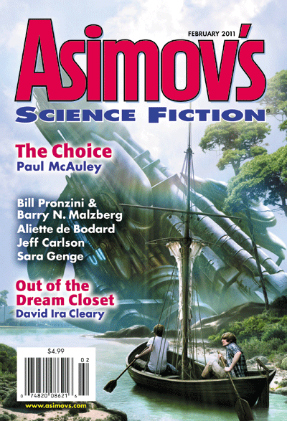
In order to feed my craving for short fiction I spent time this past week with genre magazines, both in print and digital format. I read and reviewed Issue #20 of Apex Magazine in PDF format and I enjoyed the feel of cheap paper in hand while reading the February 2011 issue of Asimov’s Science Fiction.
In order to eliminate any and all suspense, let me tell you that neither were a roaring success. While there are a few good stories here, most were examples of inspired creativity that flamed out before reaching a proper end. If the bell ever tolls the death of short genre fiction, a few of these stories could easily be paraded in front of the jury by a medical examiner as evidence as to the cause. A bit harsh? Perhaps, but this was my first experience (with Asimov’s) where more stories were frustratingly disappointing as opposed to, at the very least, being entertaining reads.
Before moving on to the individual stories in the February 2011 issue of Asimov’s Science Fiction, I would ask that you follow the link over to The Portal to read my review of the latest issue of Apex Magazine:
Apex Magazine Issue #20 Review, Click Here.
As always, your comments over there are much appreciated, as they are here. Once you’ve done that, follow the jump to learn why Asimov’s let me down this month.
Asimov’s Science Fiction, February 2011
–edited by Sheila Williams
–cover image by Paul Youll
–112 pages
–4/10
Asimov’s Science Fiction began 2011 with a bang (my review here), publishing a strong issue out of the gate and raising the bar, and my expectations, for the magazine in the coming year. That expectation has mostly fizzled with the February 2011 issue. With the exception of Paul McAuley’s novella, “The Choice”, the line up of stories presented in this issue were an exercise in frustration. Most began with promise, showcasing a degree of talent, only to end to abruptly or in an unnecessarily depressing fashion.
The issue began with an interesting editorial by Sheila Williams. The discussion of Isaac Asimov’s I, Robot and its influence on culture and technology is almost enough to make me forgive Williams’ editing choices for this issue. Almost.
Robert Silverberg’s Reflections column was as entertaining as ever. I was mentioning to Little Red Reviewer today that I am largely unfamiliar with Silverberg’s fiction, but I have been impressed on a monthly basis by his column in Asimov’s. In this issue he pens a love letter to the early genre magazines, opening a window of nostalgia so wide that I could practically smell the scent of aged pulp paper wafting in on the breeze. Really good stuff.
And now, the stories:
David Ira Cleary‘s novelette, “Out of the Dream Closet”, opens the issue. Sometimes I cannot help but marvel at the intricacies of an author’s imagination. Most recently I was pondering that while reading Jeff Vandermeer’s short fiction in The Third Bear. Those thoughts arose again as I read David Ira Cleary’s story. The universe in “Out of the Dream Closet” is as surreal as any that I have read and yet it stays consistent with an internal logic that never once rings false. It is as wacky as Pee Wee’s Playhouse yet never once seems silly. The real shame in all of this is that the story did not quite reach it’s potential.
The female protagonist in the story, a woman in her 60’s who has been kept in a perpetual 10 year old state, learns from her father’s Living Will automaton that he has decided to die. As this is unacceptable to her, she sets out with the help of a friend to prove to her father that he needs to remain alive, even if it means practicing forbidden arts to convince him.
Cleary points out that the themes he wanted to examine were “free will, aging, mortality, and the philosophy of the mind”. While he certainly succeeded in “examining” those themes he pulled up short in what could have been a fantastic tale. The characters and the universe they inhabited were very interesting, but at the end of the story arc I did not see any significant growth or change in the relationship between the characters, which left me questioning the purpose of the story. “Out of the Dream Closet” is a tale with three-dimensional visuals and a one-dimensional story. 6/10
_____
Sara George‘s story, “Waster Mercy”, is the fourth in a series of stories “set in a wild expanse outside Paris that is scarred by ecological disaster and social decline.” In this tale a priest traveling outside the city meets with an accident that leaves him at the mercy of the elements, and any local scavengers who happen to come his way. As his life hangs in the balance, he is discovered by a young child, who may be his angel of mercy, or angel of death.
I haven’t read the previous three stories in this series and although they are reported to each take place in different locations within the Waste, I did not feel the story connect with me in a way it might have had I any previous exposure to this universe. The story was too short to make an impact, especially without a connection to the previous tales. 4/10
_____
In “Planet of the Sealies”, by Jeff Carlson, humanity is near extinction and a line of strictly controlled individuals work on an archaeological dig in a hostile environment, seeking a treasure much different than the digs of the 20th century. In searching around the net I have seen some praise for this story. I found it to be little better than the vessel which held their sought-after reward. It appears to me to be yet another story lacks the fleshing out necessary to be memorable. 4/10
______
“Shipbirth” by Aliette de Bodard takes the Aztec culture to space with an interesting idea about organic ships and the manner in which they are created. The protagonist is an interesting character who changed her sex to become a male after a family tragedy involving her sister. “Shipberth” is at times eerie and at other times verges on being poignant but in the end left me feeling cold, questioning why a story that is little more than a story treatment got published in a major genre magazine. Had this been expanded to at least novelette length it had the potential to be an engaging story. As it exists it is pointlessly depressing. 4/10
_______
Tim McDaniel explores the disparity between the casual Thai atmosphere and the desire to be a player in the Asian world in his short story “Brother Sleep”. The story follows a young college student, Horse, the first in his family to be genetically altered to only require and hour or two of sleep per day. Non-altered people are known as “sleepers”, and Horse is unfortunately saddled with one for a roommate. McDaniel’s desire to examine Thai culture and attitudes as well near-future gene manipulation is not realized in a story that is little more than a handful of pages spent watching an entitled, narcissistic young adult unravel because of his selfishness. There was a bit of fun in the Thai nicknames that McDaniel employs in the story, but not enough to overcome his jerk of a protagonist. 4/10
_______
Bill Pronzini and Bary N. Malzberg continue the them of wasted potential with their thinly veiled examination of corporate greed entitled “Eve of Beyond”. Mr. Kampman took an innovative idea, making inexpensive short-lasting clothing for those nearing death as a way of allowing them to save money, and turned it into a thriving business. As is the way of business, success bred imitators and now “Eve of Beyond” is not the only option for the elderly. Mr. Kampman prides himself on his integrity and his desire to give the very best product to his customers. When his son Arthur teams up with Heaven-Sent Garments to sell the business for a profit, Mr. Kampman decides to stand on principle, regardless of the cost. The cost, however, might just be too high.
In the end, “Eve of Beyond” tries to point to something more sinister going on in the background than mere corporate takeover. The vague nature of the end squanders the opportunity to be truly sinister, resulting in a story that is simply not very nice. 3/10
_______
“The Choice”, a novella by Paul McAuley, is like a light shining in the darkness after the dysfunction and unrealized promise of the stories that have come before. Even if it wasn’t being compared to so many less successful efforts, “The Choice” would be a recommended story. Lucas and Damian are two young teens who live near the shore. Lucas built his own small boat and provides for himself and his ailing mother by hunting and trapping and fishing. In McAuley’s future earth, aliens exist but are less than welcome on the planet. When an alien ship, a sea dragon, is wrecked farther down the coast, the boys set off on a once-in-a-lifetime adventure to see it for themselves.
The theme of choice is thoroughly explored in this story, from the main characters to secondary and tertiary characters, choices big and small send out ripples that affect their lives and the lives around them. I am loathe to share much more as it would ruin the impact of the story. Despite its science fictional elements, McAuley tells a believable story in which some choices lead to bittersweet and harsh results, while others turn a young boy into a man. If you get a chance to read this story, I recommend it. It certainly saves this issue. 7/10
The February 2011 issue of Asimov’s Science Fiction is nothing if not an example of wasted potential. Each author (other than Paul McAuley) demonstrates a degree of storytelling skill that left me asking “what if?” over and over again. My only consolation in working my way through the entire issue is that the March issue of Asimov’s will be released this week. Fingers crossed that it erases the memory of this one quickly.
Okay, I’m definitely thinking Apex Magazine is the better choice, huh? At least for this month? Rich is going to get me an ereader for my birthday, and I really do think I’ll be downloading that Apex issue–thanks to your review.
Blogging has sadly taken a back seat lately for me…but the good thing about that is that I know have lots of wonderful posts from all my favorite people to catch up on. If I remember correctly, I think google reader said I have 14 posts of yours to read. 😀
(Also, I decided to give this blogging thing–the posting part, that is–one last try. Not that I’ll ever be talking about anything of much interest, of course, 😛 but I think clicking on my name there will take you to my latest (and last!) attempt at this thing. Do not feel obligated though, dear friend! We’ve got other ways of keeping in touch without you feeling like you have to read my blatherings. 😉 )
Debi: Just so you know, you can go to the Apex site and read/download previous month’s issues and they have a special going now where the entire year’s subscription is only $12 for 12 issues.
And I’ve already been over and visited you on your new site, so never fear! 🙂
It’s great to read reviews that don’t pull any punches – if it’s not to hot you say so, and I really appreciate that!
RkR: I consider myself very open-minded when it comes to stories and I believe part of my role in sharing an opinion on a story is to, in part at least, be able to look at what the author was trying to accomplish and judge it that way. In the case of several of these stories the author’s purpose was not as clear to me…unless their purpose was simply to script a story treatment to use for fleshing out into novel format later. I’m rarely this disappointed in a book or magazine and it wasn’t as easy to write negative reviews, but this is the way I felt and I needed to communicate it.
BTW, I’ll have a Fred Saberhagen review up tomorrow for Friday Forgotten Books.
Sweet, I’ll be there!