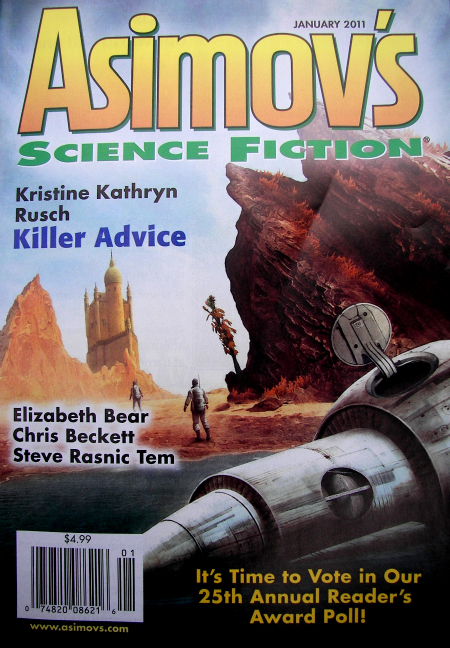
Asimov’s Science Fiction: January 2011
–published by Dell Magazines
–112 pages
–4/5 stars
The magazine industry has always baffled me. It is the second week in November, and I spent the day reading the January 2011 issue of Asimov’s. The February issue hits newsstands on December 21st. I am sure there is a reason for this, though it may be an oxymoron to call it a logical reason. Magazine time travel aside, my reason for purchasing this issue boiled down to three words: “Kristine Kathryn Rusch”. And those three words did not disappoint. However, let us take things in an orderly manner. Rusch’s novella, Killer Advice, closed this issue, so we will come back to it later.
The January 2011 issue opens with Sheila Williams’ editorial honoring the recently deceased Martin Gardner. Among other things Gardner wrote puzzles in the form of short science fiction stories that began in Asimov’s inaugural issue and continued for over nine years. In honor of Martin Gardner this issue reprints one of his word puzzle stories from the 1980’s. My enjoyment of word puzzles has always been tied to the level of difficulty. I don’t mind exercising the little gray cells somewhat…I just don’t want to get a headache over it. This one had three different parts scattered throughout the magazine. I completed the first two just fine and would have completed the third correctly if I had actually taken the time to read the directions. It was fun.
Robert Silverberg’s Reflections column contemplates far future science fiction that looks back on the ruins of civilization in light of the eighth-century Anglo Saxon poem, The Ruin. This is a fascinating piece of antiquity that I personally had not heard of but found myself wanting to know more about.
James Patrick Kelly’s On the Net column examines, Warning: The Internets May Be Hazardous to Your Health!
Two Thieves by Chris Beckett is the lone novelette in this issue. The eponymous two thieves are Pennyworth and Shoe, a couple of long time criminals who outsmarted themselves and were sentenced to the penal settlement, Last Resort. This all too pleasant, amenable punishment just won’t do, and at first opportunity, in this case a gateway portal to another place, Pennyworth and Shoe make a break for it. Beckett’s story explores the concepts of both “out of the frying pan into the fire” and “you should quit while you’re ahead”. This bit of fun reminded me of both Robert Sheckley’s AAA Ace Decontamination Agency stories and Isaac Asimov’s robot short stories featuring Michael Donovan and Greg Powell. I wouldn’t mind seeing a collection of adventures to see these characters fleshed out.
Geoffry A. Landis offers the light and fluffy poem Five Pounds of Sunlight. It is my opinion that poetry elicits an even more subjective response than does fiction. This was straight forward and mercifully un-enigmatic, but did little for me personally.
Elizabeth Bear’s short story Dolly, is a far future murder tale involving robots that felt like an homage to the work of the man whose name graces the magazine cover. I am very, very fond of Isaac Asimov’s robot short stories and Bear’s story stands proudly in the shadow of the Master. I enjoyed this one very much and the highest compliment I could pay it is that it made me want to re-read Asimov’s short story, Robot Dreams, a story to which Dolly bears a kinship. I want more of these, Ms. Bear, many more!
Next up is a short story entitled Visitors by Steve Rasnic Tem. I began the story with reservations, having not really enjoyed the only other Tem story I had read, the horror story The Man on the Ceiling. They say everyone deserves a second chance, and I am glad I gave Tem his. Visitors is a sad (and if you think about it very long, truly horrific) story that, as the introduction says, “takes a sharp look at the collateral consequences of cryobiology”. Tem builds suspense by lifting the veil little by little, slowly exposing the reader to events that called to mind a portion of the film adaptation of Philip K. Dick’s Minority Report.
The second and final poetry selection in this issue is G.O. Clark’s Retired Spaceman, a poem that reminded me of conversations found on many blogs over the years lamenting the fact that science and technology have not given us the science fictional world that classic science fiction literature prepared us for. I liked it.
Ian McHugh’s short story Interloper tells the story of a troupe of freaks traveling across the Australian outback. Interlopers is, however, far more imaginative than that one sentence synopsis implies. Creative writing instructors the world over teach that an author should ‘show’ and not ‘tell’, which is exactly what McHugh does. My only complaint is that in this brief space the ‘showing’ took up so much time that when I finally began to feel comfortable with my understanding of McHugh’s world, the story was over. McHugh introduces a terrifying enemy and protagonists with a great deal of moral ambiguity of their own, characters who are intensely interesting. I felt the story would have been better served if it had been at least novelette length if not a full novella. It is not a bad story, I just wanted more.
Ashes on the Water by Gwendolyn Clare is a coming-of-age story that explores efforts of one sister to honor the untimely death of another. This sweet, emotionally satisfying story is set in India’s future, a fact which reminded me fondly of Ian McDonald’s Cyberabad Days, despite the difference in their writing styles. Stories set in a time of hardship, in this case a water shortage and an ever-increasing arid climate, are rarely nice. But this one is just that–a really nice short story. I look forward to more from Gwendolyn Clare in the future.
The second science fiction/murder mystery combination, and the final story in this issue, is the aforementioned Kristine Kathryn Rusch novella, Killer Advice. I first experienced Rusch’s work earlier this year with her excellent novel, Diving into the Wreck (review here). As Diving into the Wreck was a novel built on two previously released stories in Asimov’s, it was a no-brainer to pick up the March 2010 issue of Asimov’s, featuring Rusch’s novelette, The Tower. It too was a fantastic story (review here). Kristine Kathryn Rusch is a prolific author, writing stories in short and long form across multiple genres, including fantasy, science fiction, paranormal romance and mystery. In Killer Advice, the rundown Vaadum Resort and Casino in an ass-end part of the galaxy finds itself suddenly filled with guests, the result of a fire on the ship on which they were traveling. Despite the lucrative prospects of paying guests, hotelier Hunsaker soon finds himself regretting his good fortune, when a guest turns up dead. One dead guest turns in to two and Hunsaker is made aware that the fire-damaged ship may have housed a murderer. What unfolds is a gripping tale with enough whodunit characters to make Agatha Christie proud.
My first impression, arriving not long after beginning Killer Advice, is that Rusch is most certainly one of the most exciting authors working on short story genre fiction today. Her stories have the kind of confident flow that you expect from seasoned authors and this particular novella was a delight to read. The editors truly saved the best for last, and what a satisfying story this is.
Kristine Kathryn Rusch has a new novel in the Diving universe, City of Ruins, due out next year and I for one cannot wait. This issue of Asimov’s ends with a handful of book reviews by Paul di Filippo (darn, the tbr list grows!) and the ballot for the 25th annual Reader’s Choice Awards. I think it is safe to say that Rusch’s story The Tower will be getting my vote for best novelette and unless she outdoes herself later in 2011, Killer Advice has an early choke hold on my novella vote for next year.
Another thoroughly enjoyable issue of Asimov’s Science Fiction Magazine. I recently reviewed the latest Star Trek novel, Typhon Pact: Zero Sum Game, which has an offer in the back for a year of Asimov’s for only $12. That is a deal that I do not think I can pass up. I’ll be calling that Toll Free Number soon!
Ya know Carl.. it’s really not hard at all to figure out your favorite books! lol
Deslily: Yes, I’m certainly not cagey. 🙂
not cagey , no.. but you write so well you are infectious! This is why those of us that join your challenges have such large tbr piles!!!!
I agree, a good issue from Asimov’s and a great deal for a years subscription that I took advantage of myself.
The offer for Analog is the same, by the way.
How can you beat two SF magazines for the year @ $24.00 !
JD: You really can’t. It is a great deal. Have you read this issue yet? Its a good one.
Deslily: I think if you spread some ointment on that it will clear up. And don’t mention it too loudly, don’t want the CDC showing up on my doorstep.
What a fun retro cover. I can see picking it up just for that reason alone. Glad to hear the interior is excellent as well. I needs me to read some more Rusch one day as well.
I think you would enjoy Rusch, she is a very talented writer.
I have to wonder what’s Retro about the cover. So get off my lawn, I guess.
Magazines throw their dates forward as much as they feel is prudent, to keep newsstand proprietors from sending the issue covers back for credit for as long as possible.
Todd: I think the ship and the guy in the space suit seems a little retro, more like the art of yesteryear than what spaceships and spacemen look like on contemporary novels…I’m thinking of Stephen Martiniere’s work, for example.
And I’m sure that is true, since I picked up the February 2011 issue this week and it is of course still December!!!