“It is good to care when you fight, so long as you don’t let it consume you. Don’t try to stop yourself from feeling. You’ll hate what you become.”
A small group of brave souls has come together in the quest to group read the first massive tome in Brandon Sanderson’s epic ten-volume Stormlight Archive. Today finds us at the tail end of the second week of our journey and I was given the great pleasure of coming up with the questions for this section of the book. If any readers who are not participating would like to join in you can find details on the site listed below. And for those of you who may have already read the book we would love to see you join in the conversation.
This is a group discussion, so expect spoilers to be present in the answers to the various questions. I would encourage you to visit the group read site for links to the Q&A for other participants.
Shall we proceed?
1. In a recent interview Brandon Sanderson mentioned that the interludes are meant to show us parts of the larger world since much of the action is focused in one or two places. What do you think of the first two sets of interludes? Any characters or situations stand out to you?
I wasn’t able to get through the first set of interludes before answering last week’s question, so much of what I will say actually comes from that very first interlude, which is one of my favorites. Ishikk is great. I loved his brief story. I think the Purelake is such an interesting setting, and I’ll speak more about it in response to one of the other questions.
Although Ishikk is probably not as old, I couldn’t help but picture as Trevor Peacock, the man who played Old Bailey in the tv miniseries of Neil Gaiman’s Neverwhere and who also played the lovable Jim in The Vicar of Dibley television series. Ishikk feels like he could be kin to the hobbits, a man who is more than content to simply live out his life peacefully in his version of The Shire, with minimal contact with strangers–“foreigners”–and with little care for what goes on in the greater world.
I love the idea of these small glimpses into the lives of characters who may or may not be important to the plot as a whole and since Sanderson states that he is not currently planning on his epic deeply exploring all the areas of Roshar, this is a great way to let the reader explore the world on his/her own for a bit while the main characters are off doing their own thing.
I am inordinately fond of Ishikk and hope this isn’t the last we see of this fisherman who is trying desperately not to get caught himself. 🙂
And before I leave it, I couldn’t help but wonder what condition one’s feet would be in if you lived your life with your feet almost constantly in the water.
2. In small increments Brandon Sanderson is revealing the geology and ecology of Roshar. What are your thoughts on what has been revealed thus far?
Roshar is an interesting place–grass that retreats into holes so that it is not trampled under foot, hoof or wheel, the Purelake which “drained into pits and holes when the storms came”, destructive highstorms that often, but not always, come with some degree of predictability. It is as if the ecology of Roshar has evolved in such a way to protect itself and thus it is not surprising that this system has generated some degree of reverence. Szeth and his people revere stone, believing themselves destined (if conditions are met) to be able to go into the stone after death rather than be forgotten. Ishikk speaks/thinks in worshipful language about the Purelake.
And the description of the Purelake sounds to me like something that would be an impossibility to exist:
“The Purelake extended in all directions, hundreds of miles wide, its glassy surface perfectly transparent. At its deepest, it was never more than six feet from shimmering surface to the bottom–and in most places, the warm, slow-moving water came up only to about midcalf”.
But it works because even with only the odd description here or there Sanderson has created a world that we expect to defy our reality-based expectations. I would love to pack up a small raft for food and water and just spend days making my way across the lake.
And then we see the interlude visit to Shinovar, where the grass behaves as grass does here on Earth–it just lays there allowing itself to be walked on. And then there are the little stones that Kaladin’s brother Tien sees beauty in that we see in the flashbacks from when Kaladin was working with his father.
We’ve just seen the tip of something potentially incredible that Brandon Sanderson is creating with his world and I cannot help wonder just where it will go as this 10 volume epic grows. I find the topography of Roshar very interesting as well, particularly the Shattered Plains. We’ve also met some intriguing creatures thus far: the spren, the chulls, the chasmfiends, the skyeels. In just 500 pages I am getting the impression that Brandon Sanderson is doing nothing by accident and I find myself becoming more and more curious as to what we will learn about the interdependence of the creatures and landscape of this world.
3. This second section of The Way of Kings featured two distinct story lines, those of Dalinar and of Kaladin. How do you feel this section of the book compares with the first section and what are your thoughts on either or both of these story lines?
I mentioned in other conversations that I felt like the pace slowed down in this second section though I don’t mean that as a criticism. Perhaps “pace” is the wrong word anyway. Part Two is merely different because it concentrates on just two story lines and doesn’t have the “from one character to the next” transitions happening the same way as it did in Part One. I think that works well for this section because both Dalinar’s and Kaladin’s struggles reveal to us the long, drawn out and possibly hopeless war that they are waging and how that war plays such a strong role in the political plots and schemes working behind the scenes with the king and the various Alethi highprinces.
While Kaladin remains a favorite and became even more so with this section and his efforts to create a team out of a band of disparate and dispirited strangers, I found myself drawn in to Dalinar’s journey, particularly the visions that he is having and how he is trying to bring together his desire to follow what is being revealed to him while also trying to honor his brother’s dying words. I found it very skillful how Sanderson used Dalinar’s visions and his growing obsession with the Way of Kings book to reveal more to the reader about Roshar’s ancient past, all the while propelling the story forward. Political intrigue is not always my favorite thing in fiction and Sanderson keeps me from becoming disinterested by, number one, making the politics interesting, but also by weaving in the history of Roshar, plenty of action, and hints that darker days are on the horizon for the people of this world.
4. In the interview set out earlier in the week Sanderson talked about the Stormlight Archive being a series about the return of magic. What are your thoughts on this, particularly in relation to the visions Dalinar is having during the highstorms?
I thought this was a fantastic idea when I heard him speak of it. One of the reasons I am so fond of The Lord of the Rings is the combination of a pervasive melancholy and a glimmer of hope. The dying of magic in Tolkien’s work is profoundly moving and sad. I like that rather than do something similar, Sanderson is talking about bringing magic back. I think Dalinar’s visions and small things that are happening with other characters are planting the seed for this magic to return. One of the things I hadn’t picked up on but thought more about as I started Kaladin’s story in Part Three is the mention of the spheres that he carries turning to dun because of their loss of Stormlight. That has me thinking that perhaps he is unknowingly drawing on the power of Stormlight in a way that has some kinship to what Szeth does. Maybe that is why he was called “Kaladin Stormblessed” in the past because his unnatural good fortune and good luck had something to do with this latent ability that he is unaware of. Did anyone else catch that?
5. There has been a change in this second section of the nature of the quotes prior to the beginning of each chapter. What are your thoughts on the opening lines featured in both sections of the book to this point?
I find it a remarkable coincidence that this is only the second of these group reads/Q&A that I’ve participated in and both books that were chosen have fragments from other works in them. Like in Dune, I think Sanderson’s introductory passages add something to the story–in this case a real air of mystery. I think it is very interesting that the nature of these brief passages changes in each section. I am unsure who it is that is taking these things down or what merit they will have with the overall story, but I don’t doubt that they will turn out to be important somehow.
6. In the questions for these first two sections we’ve talked about characters and the story lines and the world that Sanderson has created, but there are a lot of interesting flourishes and touches to The Way of Kings thus far (shardplate, spren, the actual Way of Kings book, highstorms, etc.). Talk about some of the non-character/non-setting things that you are finding either fascinating or annoying (or both) in the book thus far.
Syl had already increased my interest in the spren and that interest increased all the more in the interlude when we are introduced to Axies and hear about the various spren he has seen and other he is still looking for.
I find the idea of men not reading both disturbing and wildly interesting at the same time, especially given that we’ve seen just how important the written word is to some of the characters we have met thus far.
Sanderson is making the shardplate and shardblades so interesting, especially in light of their tremendous powers that they have weakness that have to be accounted for: their rarity, the amount of time it takes for the shardblade to materialize, the fact that it makes men take risks they might not otherwise take.
I find the religion and culture of the various peoples endlessly fascinating and love how we are being introduced to this ever so slowly through what the characters are experiencing and thinking rather than being given a set of instructions outlining the information.
I’m sure there are many more of these things that I was thinking about when I wrote this question that are now slipping my mind, but thankfully I have all of your responses to read to jog my memory.
My only annoyance thus far, except the idea of having to wait a year for the next book to be released, is one that I don’t blame Sanderson for: the editing/proof reading process. I don’t mind banging the drum of fandom for Tor Books. I think they are fantastic and employ a terrific art director (Irene Gallo), attract a wide range of sickeningly talented cover artists, and they have a great eye for publishing authors who can tell a good story. This second section of Sanderson’s beautifully produced book was a large disappointment simply because there were a great number of printing errors. I noticed a handful of misspelled words–a “her” where it was supposed to be “he” for example–and even more places in which there were grammatical errors–missing words such as “the” or “and” or “a” and in a couple of instances sentence fragments that made no sense grammatically. I don’t normally catch these things and anyone who reads my posts knows that I am no grammar whiz, but there were several times when I was reading a sentence and came to a halt because the way the sentence unfolded in my mind sounded wrong. When I read these over it was because a word was obviously missing. Hopefully these were corrected in later editions, but I am disappointed that my lovely first edition hardcover is marred in this way.
That is all for now. I’m excited to experience another week of chatting back and forth about The Way of Kings while we read Part Three and await the next set of discussion questions.
Hi Carl. I find it interesting that you don’t like political intrigue and yet the two books we’ve read together have involved a lot of political intrigue. I wrote in my discussion how I’m loving all the politics and backstabbing. I love that we have different tastes and yet we can still enjoy and appreciate the same novels.
I’m enjoying the introduction of magic. You make a great comparison to the Lord of the Rings. There was that glimmer of hope…and Sanderson seems like he wants to reignite it for all of us.
Also I’m loving Dalinar’s obsession with the Way of Kings. The author is adding a bit of mystery to the story. Dalinar wants to figure out his brother’s final words. It is a little like a detective story.
It isn’t so much that I don’t like it, it is more that it isn’t my favorite subject in fiction. I am very annoyed by politics and politicians. I’m probably being disingenuous in sticking to the idea that I don’t like “political intrigue” because it is more of a long held prejudice that probably has more to do with stuff I didn’t like a long time ago rather than a true reflection of what I like now.
I won’t take credit for the comparison since Sanderson himself made that comparison, but I do see this as him wanting to write a story that is opposite of what Tolkien did on one hand while at the same time honoring that type of high fantasy by having his own small glimmers of hope.
Dalinar’s story does have some detective elements, doesn’t it. He is like an investigator trying to puzzle out a mystery that he can’t quite grasp. It is like the answer is right there but it is still shrouded in a mist. I’m looking forward to seeing more of his visions and how those play out in the present time of the story.
Politicians and politics, especially today, can be very aggravating. But I love the study of politics. I have degrees in history and political science. So this book and Dune were perfect for me!
All of us could use some glimmers of hope. I’m curious to see how he handles magic throughout the series.
At first I wasn’t too keen on Dalinar’s visions. But I’m starting to appreciate them and I’m curious to learn more about them and what they reveal about the past. Will he learn that the past isn’t quite like what they were taught?
I draw a distinction between policy and politics. Policy is fascinating, but politics is dirty and corrupt. I studied international affairs in undergrad hoping to one day become involved in politics, but realized very quickly that I want no part of it. When reading about the Alethi nobility, I found myself becoming annoyed with them in a very similar way that I am annoyed with our own politicians. They have no idea what life is like for anyone but the nobility, and don’t seem to care about anyone but themselves.
It makes Dalinar an even more interesting figure to see how he changed from thinking like one of the typical Alethi nobility to becoming the more principled man that he is now, and how the rest of the nobility automatically assume that he’s senile. He and Kaladin both are disillusioned about the relationship between honor and war, and spend much of this segment struggling to convince others that there are different ways of going about it.
I have a hard time separating out policy and politics since politicians gain their power through supporting or opposing policies. And they gain their power how they frame their arguments about policy.
It is interesting that Dalinar and Kal are on the same path of showing their people the “way”
I feel bad for both of them, as everyone thinks they are crazy, but they seem to be the only ones who think about the impacts of and reasons for their actions.
Grace, I like the policy vs. politics comparison. I can get on board with that.
And for any complaining I do about politics in fiction, it does make for good set up for the changes that will occur one way or the other as the story goes forward. In this sense it gives us someone or something to be against as we read the story. Right now we are in some ways “for” all the main characters, even though several of them have motives that we can’t get behind.
Ah, that makes sense then, TBM. You’re in heaven! 🙂
I like Dalinar’s visions as a window on the distant past. I enjoyed the more detailed vision and hope that kind of thing continues. Not indefinitely, but a few more times would be interesting.
I liked being able to see the Midnight Essence, since nobody would know what it is in the modern world. The visions are a nice taste of what might be returning from distant times.
Exactly. The visions might just end up showing us more about how magic went away and what the downfall was for the people in the past.
Wonderful Q&A 😉 Can’t wait to hear more.
Thanks Kelly! I miss you. Haven’t been on Twitter lately. The CEO of my company died and it has been a pretty devastating last week. Just came back from the funeral and will have to try to go back to work tomorrow and step up to fill the gaps that are left without him there. He was a pretty dynamic individual.
Carl. I am sorry to hear about your loss. I wish you, his family, and everyone the best with dealing with this loss.
Thank you. He could be a really tough boss at times but he was brilliant and dedicated and very forward thinking. I consider him a true mentor. He taught me many things, especially about myself, that I wouldn’t have learned under anyone else. He challenged me to do things in my job that I hadn’t done before and now enjoy very much. He will be missed, but we have a good leadership team at the mental health center and we will come together and press on.
Awww I miss you too Carl. I’ve barely had time to go on myself lately so I’m playing catch up. I’m so sorry for your loss. I’m sure going back to work and not having him there will be very difficult for you. My thoughts are with you, your fellow colleagues and your family as well. Time seems to be the only thing that eases the loss of people we care about. It doesn’t take the pain away, It just softens the sharpness of it a bit. I wish you all the time you need my friend, and I’m here if you ever just want to talk or vent.
Thanks Kelly, I appreciate it. It is an odd thing to lose someone you weren’t close to on the emotional level of a friend but that you counted on to be there to lead you, counted on for advice and direction, and counted on to do things to piss you off and things to challenge you. Its going to be an interesting transition at work, that is for certain.
The weakness of the Shardblade you mentioned, how long it takes to summon, is really an awesome subtle fact. Like mentioned, ten hearbeats depends on how excited the person is. It could be ten very long hearbeats, or ten very short ones. But this makes me wonder back to the Old Days, to times like the vision Dalinar saw. Were these Plates and Blades more powerful, not requiring the ten hearbeats timespan for summoning?
I’m also loving the distinction between men and women of Roshar. Women being the readers, writers, engineers, and learned people is a beautiful concept, one that smacks modern society (and typical fantasy) in the face. And what’s with the safehand? What’s the history here?
And I definitely suspected something was up with Kaladin’s spheres losing their charges so quickly. The scene when he was haggling with the apothecary hinted quite strongly at this, and I’m with you on your thinking: the lad’s somehow drawing strength/luck/magic from Stormlight, which is why he’s so blessed.
What is with the safehand?
Also, I am very curious why men don’t read. What’s the reason behind this?
Yeah, not sure. Masculine arts vs feminine arts makes for an interesting culture, that’s for sure.
I think the safehand is an arbitrary modesty thing in their culture. Considering that we’ve gone through periods in history when showing a little ankle was scandalous, it isn’t that far-fetched. I do think it would be difficult having to learn to do everything one-handed though.
On a side note. It is difficult. I’m accident prone and one year I broke my right thumb twice. Both were freak accidents. I had to learn to write left handed. But I did adjust quickly. However, I can no longer write left handed.
Yikes, TBM, that sounds horrible.
I was a kid. You heal quickly then. I’ve broken weird bones. Fingers, knee, and elbow. Now I know when it is going to rain though.
This explaination is not directly in the text, but I have been told that the safehand started via a observation of a scholar long ago that Masculine Art were about destroying and required twohands, while the Feminine Arts were creative and could be done with only one hand. The covering of a female hand started from this philosophical observation.
In case you hadn’t noticed I love this book and all of Sanderson’s works, which you may be interested in knowing take place in the same universe and have a shared overarching ‘cosmere’.
Thanks for joining in Ashaman. Hope you do so again as we continue our discussion on the book.
Logan: Glad I’m not the only one seeing that there is something with Kaladin and the spheres. Looking forward to more being revealed about that.
Hadn’t thought about how the heartbeats worked that way. I was taking it as more of a poetic license but it does make real sense that it would be based on the actual heartbeat. Wonder how much if anything the adrenaline has to do with it. It is a definite weakness and one that I too wonder about. Is it just a recent thing or was this always the property of a shardblade?
The distinctions between the men and women really are interesting, and they don’t seem to me, at least at this point, to be based on some idea that certain things are “women’s work” vs. men’s as much as they are based on cultural/spiritual traditions.
I was thinking the same about the gender roles. It will be interesting to see how the different gender roles in the different cultures come to clash as the story moves about Roshar because you know there has to be differences in Roshar just as there is in our own. It’s when those differences collide that makes a fun story.
Wow. Loganstewart. Thanks for pointing that out about Kaladin and the spheres. I hadn’t noticed that. I will look at that more closely going forward with him.
I also love the fact that there money provides light. What an interesting function for there currency as compared to our own world.
I’ve been thinking about the way shardblades are summoned, too. The ten-heartbeat requirement certainly adds a degree of vulnerability to the process. I’m curious, too, about how they’re transferred. They must bond to their bearers, as they don’t have physical form until they’re summoned by a specific person, so they must have a way of telling who they belong to. I wonder if it’s an unconscious, magical bond of if there’s a hint of sentience somewhere in there.
Also, for what it’s worth, it seems like most of the tyopgraphical errors were corrected in the paperback. I didn’t notice anything particularly jarring.
Glad to hear about the errors, Memory. I figured someone must have caught them. I’m disappointed they are in the hardcover, but imagine I’ll live. 😉
I’m so thrilled that 500 pages into this first book we still have so many questions about things large and things small. Really bodes well for some interesting revelations in the subsequent volumes.
Okay, after a lengthy comment went away, I’ll try again. (grrrr).
A few comments by a non-participant. Shame about the poor editing, I’d think at this level that would be solved. Such mistakes stop me in my tracks too. I rarely read the quotes or comments at the beginning of chapters in books until the second reading. I find for the most part they are the author showing off and not germane to the story. I usually prefer to just sit back and enjoy what I’m reading than do all this analysis and comparison. I can pick up all the nuances and connections next time around, hopefully, and so enjoy the story itself. Sounds like there are many interruptions (interludes) that would distract me. I’m enjoying the reader feedback on this one, thanks.
RkR, I was spending so much time going back and reading the material at the beginning of the chapters until I decided I would be better of doing what you say you do–waiting until the end to figure it all out. Good strategy!
A few thoughts from a non-participant. It certainly seems you are enjoying the reading so far. Great. Shame about the poor editing, that stops me in my tracks as I read too. I rarely read quotes or comments at the beginning of a chapter until the second reading. I’ve found in the most part they are more a device the author puts in to show off than anything that’s essential in any way to the book.
Oh great and now both show up… Double grrrr. Sorry.
Don’t you just love the internet, Richard? 🙂
Actually the interludes aren’t an interruption that all. He does a really nice job. They only come at the end of a very lengthy section of the book focusing on the various main characters and provide a nice brief respite and then transition to the next part. Patrick Rothfuss uses interludes in his trilogy too, in a very different way, and they work really well with the story also. I haven’t read a ton of this kind of fantasy so perhaps this structure isn’t all that unique, but I am enjoying it.
I’ve been reading the comments about summoning the shardblades taking ten heartbeats. That’s 10 seconds, right? That’s not long at all. I’ve read many fantasy novels in which it takes an hour to cast a spell (Katherine Kurtz is an example). But maybe I’m missing something here, since I’m not reading.
I admit to being put off by the concept that only one gender is skillful and educated in the society. It sounds as if the men are just drones; fighters and the like. If that’s the case, then the leaders are also women, I assume.
I think that is about right, Richard, which truly isn’t a long time unless of course something is bearing down on you and then I would imagine it feels like an eternity. Also if you happen to let go of or drop your shardblade it disappears and you have to wait once again. Very inconvenient in the middle of a battle. I like that aspect, though, as the wearers of shardplate are very strong but I like that they have some weaknesses that keep them from becoming invincible comic book heroes.
You bringing up Kurtz reminds me of the way Jack Vance handles magic in his Dying Earth series, with a limited number of spells a person can “carry” at any one time because of the need to memorize each spell each time it is used, and having one use only. It means the characters have to act intelligently to strategize before they set out. I think magic having some degree of limitations makes for more interesting characters and more interesting storytelling.
The whole way that Sanderson is handling gender roles is actually much more complex, because while men are leaders they have an interdependence on women to send messages, read messages, pass on knowledge from texts, etc. It is in some ways inefficient but it is also a very interesting culture/religious aspect to this world and I suspect as we go along we will find out more of why this developed this way and I suspect we’ll see some changes occur in this as well. But rather than being a purely black and white situation regarding gender roles there is some interesting complexity to the system Sanderson has set up and it makes me very curious as I read it.
Ah, but then how clever and potentially powerful would be a man who had learned – secretly – to read!
Richard, it wouldn’t surprise me if that happens in the book. We’ve already seen minor characters (a boat’s captain, a bookshop owner) who Shallan can tell are readers.
I hadn’t thought about the spheres turning dun because of Kal directly–I just though someone gave him bad ones (but I do remember whoever gave it to him (was it Gaz?)saying they had just been replenished by the storm. So I think you’re right. Kal’s mood also improves when Tien gives him the stone when he’s young. I wonder if they’re connected somehow.
The ten seconds required to summon the shardblade seems meaningful to me because Sanderson talks in the interview about ten being a holy number in the books. And I like the fact that it involves some mental exertion rather than just physical strength and power.
I noticed the types as well, and they were bothersome, but I think I would be more annoyed if I had bought the book. Mine is just a library copy. In any case, there’s just no excuse.
Shelley: there is particularly no excuse for a company the size of Tor, especially given the fact that this is a rarity in their books. To do this to any author is unthinkable to me, but to do it to one who has already proven successful and you are wanting to market 10 volumes of this work to an audience I would think you’d do a better job of putting out a really good quality product.
I thought the same thing about the spheres until early on in this third section where it is casually mentioned again. At that point I realized there just has to be something with Kaladin drawing the light out of the spheres.
And how cool is it that this system of money: stormlight infused spheres, isn’t just used for currency but is also used in lanterns and lamps to provide illumination.
I just noticed that I mistyped “typos.” How ironic…
I can’t wait to find more out about the spheres and the stormlight. Haven’t started part three yet.
That is great! I do that kind of thing all the time. Gripe about spelling or grammatical errors and my comments are full of both! 🙂
I was excited to discover this way of kings discussion since I happen to be reading it myself right now. At first I was taken aback by the book’s size, especially since I can only read it on the weekends, but now it’s become my “never-ending story” that I can alway turn to and I think I’m going to be very disappointed when it eventually ends.
The political parts are also not my favorite sections of the story and my attention always wanders a bit when the story switches back to the Dalinar plot line. I had particularly had time in the beginning with the story jumping back and forth between the different story lines but now that I’m about halfway through I’m relieved to see that this doesn’t happen quite as frequently so I can relax into the story a bit more. Though I always get a bit tense when the story jumps to Kaladin’s past because I know that something bad is going to happen to his brother and I’m dreading it.
I’m just dreading what happens with Tien in the past as well. 🙁 I just have a bad feeling about it too.
That is great, Simcha. Do you want to be included on the email list for the weekly questions? We would love to have you join in our discussion.
Yeah, sure.
1. It’s funny you mention that about Ishikk’s feet. I was wondering the exact same thing about what one’s feet would be like if they were in water all the time. I know I wouldn’t like it. 🙂
I also was very interested in Szeth’s story after reading his interlude. I’m hoping to read more about him in the future.
I also think these interludes add to the feel of the epic size of the tale that Sanderson wants to tell. It’s like he wants to let you know this tale is going to effect all of the people of Roshar.
2. I’m blown away by the detail that Sanderson is using to paint the picture of this world for me.
He mentions seasons that are short and changing so unlike our own world. I have so many questions about the spren. I love the grass and plants that can retreat to protect themselves. It calls to mind images of our ocean floor that he has used for his worlds plant system.
3. First off I miss Shallan’s storyline so I hope she returns in part three.
While I do feel the pace slows in this section of the book I also feel that a sense of dread is building. Dalinar’s worry for his country and where it’s heading builds and I’m increasingly worried about what has happened in Kaladin’s past with Tien and Laral.
What I’m also starting to appreciate it seeing the story play out through both a father and son’s eyes.
4. Kaladin Stormblessed. I did not catch that about his character. I think you may be onto something which I will have to look forward to going forward.
5. I liked the change to one’s that weren’t tied to death. The one’s in the first section creeped me out. I like the air of mystery they provide and I know that Sanderson will provide a pay off to them later. I’ll probably go back and read them all again when the book is over and see if they mean something more once I have finished book one.
I wonder if any of them will be passages out of the Way of Kings book.
I really dig how the title of this book is an actual book in the story. I just find that neat.
6. I’m intrigued by a lot of the non-character/non-setting ideas.
Why do the men not read? That shocked me. I would imagine that some men learn to read in secret.
The fact that men and women don’t eat together and the differences among the spices of the foods for each gender.
What is it with the gloved and safe hand part of the story? I want to know what that’s all about.
I know there’s more things I should bring up but I can’t remember them right now. Argh!
Fun questions Carl! Thanks for hosting!
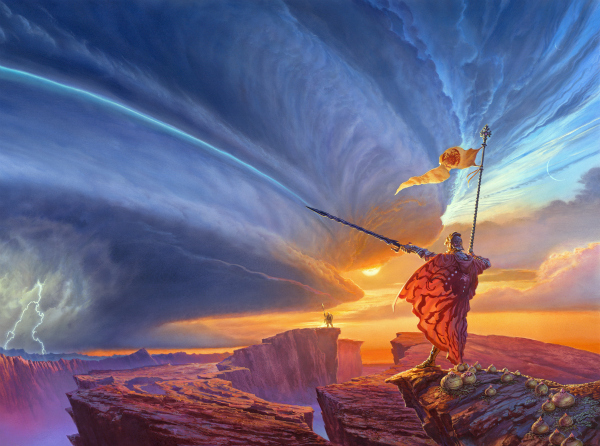
I also can’t believe I forgot to mention how much I love that imagine you found for this part 2 post with just the art work from the cover minus all the text.
It just looks amazing. Michael Whelan is an incredible talent.
I just went to Google images and searched Way of Kings and then filtered it by Large images, and lo and behold I found varying sizes of this image. Which is great because I am using a very large one as my desktop wallpaper and it is gorgeous.
I like that the novel is leaving us with a lot of questions as that just engages our interest not only in the rest of this story but also in the novels to come. As time goes on I am becoming less and less worried that Sanderson has ten volumes worth of story to tell.
I couldn’t be a “proper” man in that society. I’d be reading on the sly, no doubt about it.
Very interesting about the food stuffs for men and women. You see that come up again in the third section with Shallan and one of the Ardents.
Like you I suspect there is something really bad in Kaladin’s background and I am not looking forward to that being revealed.
I agree with you about the interludes also letting us know that events to come won’t just effect the area of the land the story is focused on but will affect everywhere.
I rather liked how Sanderson let his female characters have brains. That was nice. I’m thinking that if I lived in that society though, I’d have to sneak around and steal some of the men’s food. I can’t deal with sweet all the time.
I also hope that the other ten books are released in a timely manner. I already finished this one, and I crave MORE!
LOL, for some reason your opening line in this comment made me think of zombies. “Braaaaiiinnnsss….”
Anyway, moving past my weirdness I see that you are admitting to having finished the book as well, eh? Shame on you!
Just kidding, I’m a long way from doing so but plan on finishing early myself so that I can keep up with other reading commitments.
I also appreciate that Sanderson allows the women to think, read, and write. However, I’m confused as to why there has to be a division. Sweet food all of the time would be too much, but the jam sounds pretty good.
I knew you would finish this book ahead of schedule! Good for you. I’m a little behind this week so I need to catch up tonight.
Yes, that Grace she is speed readin’!!! 🙂 I’ve got to kick it in gear tonight or I’ll be in danger of falling behind this week instead of getting ahead.
I’m in the same boat Carl! I need to get it done before I go to NYC for 5 days…Yikes!
Dude! I wouldn’t consider you a proper man in our society. :0
That is cold, my friend. Cold.
Ha ha ha ha ha ha…
tee hee 😉