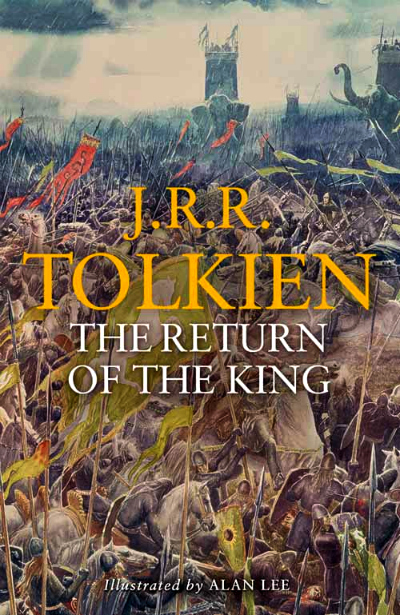
The major battles have been fought and won. The One Ring has been destroyed. There is hard won victory and the bitterness of death and destruction. And this is only part two of our discussion!!!
This middle section of The Return of the King is a densely packed section of action, adventure, introspection, hope, despair and triumph. I couldn’t help but tear through this section. Even though I remembered much of it quite well, I could not stop turning the pages.
I had the privilege of coming up with the questions for this part of our group read. Please join us in our conversation.
1. After witnessing the events of Denethor’s demise, what are your thoughts on him as a father and as a ruler, especially when compared to what happened with Boromir and the Ring.
We discussed this to some degree in the last set of questions, but allow me to expound upon my thoughts a bit more. Woven into the tale of Denethor and Boromir Tolkien gives us small threads that, if followed, allow us to better understand both of these characters and at least opens the door for us to have some empathy for them. Or at least for Boromir. In my comments in the Fellowship discussion I mentioned many times that I feel Boromir is meant to represent the common man. His temptation and ultimate failing are in part because of his make up but are also born out of a sincere compassion for his people and a desire to see them be victorious. I suspect Denethor began on that same road but his slow-building animosity towards the line of kings and feeling that the stewards were not held in high esteem clouded his judgement and made him easy prey for the evil of Sauron that seeped in the more he gazed into the palantir.
As a ruler he spends his days sitting on a plain “throne” in the shadow of a mighty throne that has long been empty, with only rumors and prophecies to point to the line of kings being restored. It is little wonder Denethor became bitter. In his son Boromir he sees a like passion and he obviously pours all his love and hope in Boromir and has no use for Faramir. Even at the end any affection he shows for Faramir is suspect, at least for me, because he has spent so much time in his own narcissistic counsel that I have a very hard time seeing any good in him. I think it is there if we want it. Tolkien is very skillful in giving small moments of dimension to his characters that allowed them to be viewed more fully if the reader so chooses. Occasionally I can empathize with Denethor. But on this occasion I just couldn’t. He is a mess and I hate to think of the baggage Faramir will have to deal with in his own future because of having such a father.
2. Instead of riding into the city with pomp and circumstance, Tolkien pens the king’s return as a clandestine act in which he demonstrates his rightful place through the act of healing the wounded. Your thoughts?
This frankly is one of my favorite parts of the trilogy. I have mentioned before that although I don’t see anything allegorical about Tolkien’s work, I do feel that his beliefs inspire what he wrote and that is very apparent in the character of Aragorn. There is a certain comparison that can be made to Jesus in Aragorn’s role of being a healer and having prophecies about the king returning and having healing in his hand. Don’t misunderstand me. Aragorn is not Jesus nor is he meant to represent Jesus. But there is a beauty to the story of Jesus bringing healing to the sick and downtrodden and that beauty is reflected also in Tolkien’s creation of Aragorn.
I think the story is so much better because, while Aragorn could have ridden into the kingdom with all the grandeur that was his due, he instead chooses to sneak into the city to do what is most important, use his healing knowledge and arts to help stem the tide of losses due to the battle that had just been fought. It is a true act of love and self sacrifice and a demonstration that Aragorn is and will be the kind of king who has his priorities in the right place. The whole Houses of Healing section of the book is lovely and I enjoyed re-reading it so much.
3. For one chapter Sam got to be rescuer and ring-bearer. What are your thoughts about Sam’s brief time as a ring-bearer in comparison to the others who have born the ring, or wished to?
I applaud Tolkien’s decision to give Sam the opportunity to be a ring-bearer. There is an honor (including a delayed future honor) there that Sam earns with his selfless heroism and I am so glad Tolkien gave him that moment. In addition to allowing Sam to have a much closer connection to Frodo and understanding of just what Frodo has been going through carrying this burden, it gives Tolkien the opportunity to reiterate for the reader just how powerful the evil is in this ring. Sam only carried it for a brief time, but even he had some reluctance giving it up and felt some of its pull in that brief time. I imagine part of the reason the reaction was so quick with Sam was the ring’s proximity to Mordor at that moment.
It is a moment in the story where Sam, unbeknownst to him, gets a great reward for his service and gets to shine and as fond as I am of Sam I am thrilled that he has that moment.
4. In a twist unexpected in many hero tales, Tolkien ends the journey into Mount Doom with Frodo ultimately failing at his task. How did you feel about this and ultimately how does it make you feel about both Frodo and Gollum?
I have mentioned before that I first experienced the story of The Lord of the Rings by seeing the films. I was not familiar with the details of the story and I avoided all spoilers, so when I saw The Return of the King for the first time and saw Frodo turn back from the brink and refuse to destroy the ring, I was devastated. I felt all the air pushed out of me as if someone huge had sucker punched me and that feeling lasted well after the closing credits. Don’t get me wrong, I loved the film, but I can recall as clearly as if it just happened how I walked through the parking lot to my car in something of a daze, pondering the feeling of despair for Frodo in his ultimate failure.
This is one of the scenes in Tolkien’s book that makes me scoff at those who have and would try to pigeonhole Tolkien’s stories as being standard fantasy fare or accuse his characters of being two dimensional or strongly black and white. I think these works are anything but, and Frodo’s failure is one of many such moments that point to how bittersweet and filled with melancholy Tolkien’s fantasy epic is. When all is said and done I ache for both Frodo and for Gollum. I find it beautiful and tragic that Bilbo’s pity, echoed by Frodo, ensured that Gollum had his part to play, a part upon which the success of the mission ultimately landed. But I ache for them both. I hate that Frodo does not succeed and that this knowledge plus his Weathertop injury affects his ability to reintegrate into the life he so loved and cherished before his adventure began. I pity Gollum too and am saddened that his final moment of peace is also his demise. The ring had to be destroyed, but Sauron did not entirely lose as he struck fatal blows to so many in his fall.
And while this part of the story always makes me hurt, I am so proud of Tolkien for writing that kind of story. There is a level of authenticity there that is not present in a lot of fantasy. It is an authenticity built upon the idea that life is going to be full of tragedy and moments of despair but that if we just cling to hope and are willing to do our part then “there is still good in this world…”. It is the deeper revelation of themes like these that makes Tolkien’s work so popular all these decades later and is the reason that criticism of his work by naysayers falls flat and looks so very silly.
5. Given that The Lord of the Rings is largely about an all male cast, what are your thoughts about Tolkien’s portrayal of Eowyn now that we’ve seen the course of her journey through these culminating chapters of her story?
We have talked about this to some degree already as well. I mentioned in earlier comments that there are no wasted scenes with Eowyn. While she does not have a great deal of “screen time”, when she is present in the story there is a lot going on. I think Eowyn is one of the most wonderfully realized strong female characters in fantasy. She does not pine for love yet at the same time demonstrates that she has the ability and desire for that. She longs for the glory of battle but is at the same time a graceful, lovely woman. She wants more than her gender role has allowed for her to have and when the time comes she not only seizes her chance but she has the empathy and kindness to be able to see beyond her own desires in the way in which she provides the chance for Merry to also fulfill his longing to be a useful part of the fight. Some of Tolkien’s very best and most meaningful lines are uttered by Eowyn and in the end she has one of the most pivotal roles in the entire victory. I think it is fantastic that Tolkien wrote her this way.
6. Much of this section of our reading has been filled with desperate acts with little hope of success. How do you feel about the mood Tolkien created in the build up both to the battle and the final push into Mount Doom and what are your thoughts on how these sections ended?
I am always exhausted after this section of the story, whether I’m reading it or watching it. So much hope and desperation, fear and death have led up to these climactic moments and when the dust clears there is victory but it is a painful victory that enacts a high cost. Tolkien’s world is not one of “happily ever after”. Some of his most prominent characters die, and not all die with dignity or glory. Evil loses but it doesn’t bow out graciously and its sting is felt long after the events of this part of the story are history. The mood that Tolkien sets in this story is one that I always feel inspired by. There is something real there upon which one can build a foundation.
In Tolkien’s universe the best things are often attained at a cost. Sacrifice is necessary. Good will triumph but only if a combination of exceptional and average individuals come together to do their part. And in victory there is still pain and death and loss. I’ve used the word “beautiful” several times in this post and I just keep coming back to it. There is a beauty in The Lord of the Rings that is akin to the beauty of winter, when the trees are bare and the host of nature is at rest. There is a stark, cold and melancholic beauty to winter and that is what I see in Tolkien’s creation. It speaks deeply to me, which I will discuss more in the final section of this group read.
7. The “assigned” sections for the next section only take us to the end of the actual story. Will you be reading the appendices?
Oh my yes!!! There are so many little gems in the appendices of The Return of the King and it is well worth digging these out by reading the appendices. And if you are like me, you aren’t ready to entirely leave these characters you’ve grown to love just because the story has reached the end, so the appendices give you a chance to spend some more time with them, and with Middle-earth.
Even if you choose to just pick at them later on, I do hope you take the time to read them.
Well, that is it for this section. I’ll return in the next day or so to finish up my discussion of The Return of the King. In the mean time I would love to hear what you have to say.
Brilliant post – spot on! Your enthusiasm is infectious (I’m even tempted to read the appendices now! Although in fairness I probably won’t end up doing so.) I loved Sam’s brief spell as a ring bearer and like you say it gave him an appreciation of the actual burden that Frodo carried, plus I loved the way in his vision of himself using the ring he was imagining strolling up to Sauron’s tower and challenging him and then turning the valley into a beautiful garden with fruit bearing trees.
I don’t like Denethor – primarily because of the way he treated Faramir but also because he is bitter and twisted – I suppose that in a way even though he never managed to have possession of the ring it has managed to have possession of him and in doing so turned his mind into something mean spirited – I hate to think how he would have behaved if the ring had actually falled into his hands!
Lynn 😀
Thanks
In my admitted prejudice I will say that you are missing out if you don’t read at least Appendix A part v, the story of Aragorn and Arwen, and the Later Events Concerning the Members of the Fellowship timeline in part B. But to be honest, both Appendix A and B are really must reads, there is so much great story material there.
I like Sam’s vision as well, even though it would have turned out to be a truly ugly horrible thing for him just like it would have for Galadriel (or anyone else who wielded the ring).
I agree with you. Certainly the evil that possessed the ring also possessed his mind, largely because, like Sauron, he was gazing into the palantir and didn’t realize that Sauron was manipulating and sewing evil thoughts in his heart and mind by doing so.
Okay, I think I will read at least Appendix A and B – but, slowly, at leisure, between other books. My LOTR book is always at hand anyway, so I can just pick it up as and when.
Lynn 😀
That is what I am going to do, I’m going to savor them over this month.