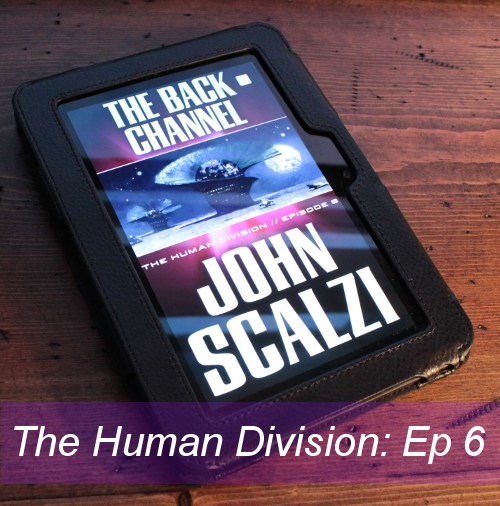
It is week six in the episodic release schedule for The Human Division by John Scalzi. Each week thus far the stories have alternated between an A storyline and a B storyline, with the B stories revealing details that have already begun to become very important for the main characters. It has been interesting to watch this dance.
This week is a B storyline that puts the reader into heart of the Conclave, a political entity made up of 400 races, none of which are “human”. We are made witness to a town-hall meeting conversation that gives us some idea of the various positions the Conclave holds in regards to humanity and their continued existence.
This episode represents roughly the half-way point of the novel and through most of the chapter it feels as if Scalzi is giving us a bit of a breather, yet he manages to put a moment of tension within the episode that encapsulates the knife’s edge upon which humanity is now walking.
I will get into a more detailed discussion after the jump for those of you who are reading along. For those of you waiting for the release of the full novel before you return to the universe of Old Man’s War this is where we part company, at least for now.
“The Back Channel” is primarily a conversation between the leader of the Conclave, General Gau and his advisor Hafte Sorvalh. We see Gau and Sorvalh in the council meeting as another representative of a Conclave race, Unli Hado, outlines the anti-human position that many races of the Conclave hold, primarily because humanity has appeared to take a “shoot first, ask questions later” path towards colonizing space.
This was not my favorite chapter, not the least of which because political machinations, while interesting, are not my favorite form of entertainment. It is also one of the few drawbacks to this weekly release schedule that a “slower” chapter like this feels less fulfilling knowing that there is now a seven day wait to get back to the story. That being said, I still enjoyed my foray into The Human Division this week because it does set things up nicely for more drama in episodes to come.
“The Back Channel” more firmly settles the divide between the people of Earth and the Colonial Union. I’m very interested to see where John Scalzi takes this story thread. This episode also serves to reminds us that there really is a lot going on in this universe, not the least of which is the mystery behind all the ships that are disappearing at or near human space. Do any of my fellow humans out there feel like we are being set up?
One thing I will say about the “political” nature of this episode is that I do appreciate that John Scalzi is giving us a story in which there aren’t clear black and white stances between humanity and various alien races. It reads as a more authentic representation of what it would be like if we discovered life out there among the stars. What mars this complex view is the brief interlude where we are introduced to a cliched stereotype of intolerant humanity in the form of a specific wildcat colony. I will go on record here to say that I don’t believe John Scalzi is necessarily trying to make a political statement here. Having regularly witnessed John Scalzi’s gleeful evisceration of those whose political or social agendas do not match with his, I think what he was really doing was tapping into an area that is fun for him to address. I just wish it hadn’t been so clearly one-note as it rings false when compared to the complexity witnessed within the rest of the episode.
So there you have it, another fun Tuesday with the prospects of seven more on the horizon. I’ve noted before that I think this grand experiment is a successful one. I would have long since devoured the book by now and would be on to something else. This weekly release is forcing me to savor the joy of spending time in one of my favorite created universes and I intend to bask in every moment. Until next week…
My pre-order arrived at 11:30 last night… so I was done before Tuesday. It sure is a long wait between chapters.
I wasn’t too fond of that wildcat colony description but I think it makes sense. We have groups today who don’t like human diversity and seek smaller controlled environments (I am sure you can think of several from recent history). So it would make sense that such groups would seek the ultimate isolation.
Looking forward to #7.
I wrote today’s ‘review’ hot on the heels of reading the story and the more I thought about it later on the more I realized that, even though the description was somewhat annoying to me, I’m not sure how else John Scalzi could have presented that colony in the manner he needed to in order for it to serve the story the way he intended.
One of the genres most over rated writers.
His first novel was quite good but don’t waste your time on the second.
Appreciate your opinion, Maddog, even though I don’t agree with it in the slightest. While Old Man’s War is arguably the best of the series, the rest of the novels are enjoyable and as a whole tell a story worth reading.
Scalzi does have a big reputation and whether it is deserved or not is not something I feel qualified to speculate about. He writes a certain style of genre fiction, one that I think pays homage to some of the great writers of the past while putting a contemporary spin on it. This is space opera that is more character driven and I believe its popularity is such because it is accessible to those who don’t generally read a lot of SF and also because they are fun stories where you actually care about the characters.
Now I acknowledge that this is merely my opinion, but there it is. 🙂
Ah look a troll.
you bring up a fascinating dilemma with the serializing of chapters, that some might interest a person and others not. In a collected work you would read it, but know there is a following chapter immediate to reinvigorate your interest in the story. It is unavoidable, I suppose, but better to meet the less interesting “chapter” late when the greater investment is there?
I also suspect, L, that was is less interesting to me is much more so to others. I’m comparing this to other chapters that I’ve liked better too. And you are right, I think there are risks to doing it this way. One thing I’m really curious about is the nature of bringing things up to date which happens to a small degree every few episodes. I’m not sure whether or not John Scalzi would have written it this way if his intention was simply to do another novel in the universe rather than a series of contained episodes like this and I’ll be really curious as to how readers react to it who only partake of it in the novel format.
Another solid chapter. I too could have skipped reading about the racist wildcat colony as well. Certainly a weak point by Scalzi. The town hall scene reminded me of the big council meeting in Star Wars with Amidala and the Emperor. Shudder. A SW prequel image.
As for Scalzi switching back and forth between the A and B story lines I think it might be tough as we reach the final three or four chapters.. In novels I’m used to a gradual build up until some big event happens right before the end. It’s going to be hard to ramp up that tension with the weekly episode time release schedule I believe. I hope I’m wrong though.
I think you are right. I don’t doubt that there will be a ramp up to the ending events but I even if each episode at the end is killer it will be hard to maintain the same tension over the course of several weeks. I’m excited to see how he will try though.
I had some SW prequel imaging going on there as well, which isn’t necessarily a good thing.
Received the full book of episodes a while back and need to start digging in! While I appreciate the different, episodic take – with the feel of a weekly TV show… I’d rather read them all at once. Helps to keep my memory fresh on events.. especially when I read so much!
I can understand that and I’m sure I wouldn’t be able to resist reading straight through if I had all of them, but I am really enjoying this the way Scalzi intended. I do sometimes think I should go back and re-read episodes to make sure I’m not missing stuff.