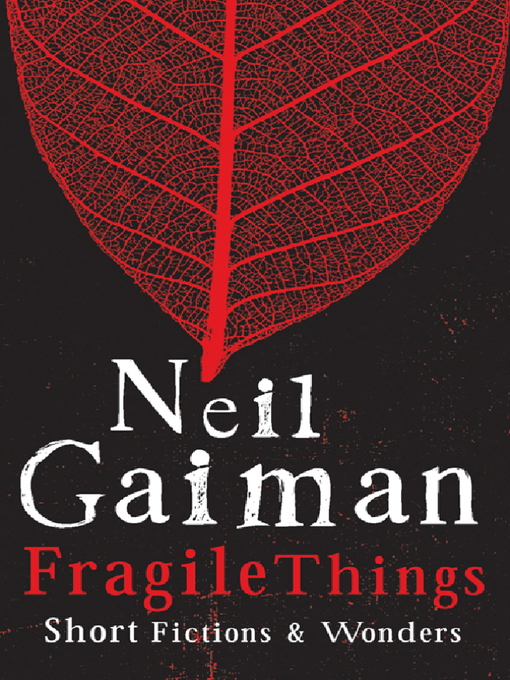
“It seemed like a fine title for a book of short stories. There are so many fragile things, after all. People break so easily, and so do dreams and hearts.”
As dawn breaks on this chilly (almost) Autumn Sunday, I sit here with a contented smile on my face, ready to put the finishing touches on Week 2 of our group discussion of Neil Gaiman’s short story collection, Fragile Things. We had a great discussion last week which has me even more excited about this week’s four selected stories.
By way of spoiling my forthcoming thoughts on the four stories for this week, there were no misses for me in this week’s grouping either. I like them to varying degrees, but all were stories I enjoyed the first time I read them and I enjoy them even more now.
And speaking of “spoiling”, the Fragile Things Group Read encourages an in-depth discussion of the stories in question, so spoilers will be present in the posts of participants, to varying degrees, and also in the discussion.
Enough preamble, let’s talk Gaiman!
- The Hidden Chamber
“Do not fear the ghosts in this house; they are the least of your worries.”
Is that not a fantastic start?!?! This is another of Neil Gaiman’s poems, although it is less lyrical in the offering, especially compared to The Fairy Reel. Gaiman’s reading of it is especially chilling, as he does so in a calm, almost soothing voice that belies the evil of the speaker.
Of this week’s stories this is my least favorite of the bunch, but I am fond of Bluebeard stories and I think Gaiman does a nice job of telling one that is a bit less up front than others and is more enigmatic and mysterious.
The speaker’s true evil is hinted at in a truly haunting way when compared to the gentle manner in which he treats the monarch butterfly who happened to wander into his home recently.
The speaker mentions that he has broken with tradition and that the lady will find no locked room in his dwelling. I often contemplate when reading/listening to this if the locked room in question is his heart, and when the lady eventually works her way in then the true nature of Bluebeard must emerge.
I have always found the ideas in Bluebeard stories fascinating. The beautiful woman who comes home with her loving, adoring husband. The mystery of a large home where she has free reign except for one room in the house. The curiosity that eventually gets the better of her and the horror that she finds. Her inability to escape the same fate as her predecessors. Whether reading a story or seeing a film version you always want to scream, “don’t do it” when she finally sets out to discover the mystery behind the locked door. I always wonder how the story would unfold if she chose to be the “obedient wife” and didn’t unlock the door. Would it cure the monster inside of him? Would he contrive ways to continue making her curious until she opened the door so he could kill her? Would his true nature take hold of him to the point where he eventually killed her despite her faithfulness to his rules?
- Forbidden Brides of the Faceless Slaves in the Secret House of the Night of Dread Desire
I am most curious about the reactions of the participants to this story, in large part because it is one of my most favorite short stories, period, and I suspect that I am in the minority about this one. Gaiman mentions in the intro how he wrote this story and was told it was no good and so he stuck in away, where is rested patiently for twenty years before he rediscovered it, loved it, and tweaked it a bit (including shortening the title, which cracks me up and makes me want to know what the longer version of the title was) and now we can enjoy it.
The reason I love this story so much is that it is an almost campy version of all the gothic troupes that I love so much, but it is done in the kind of loving, not mocking, manner that makes it as much of a pleasure to read as all the old melodramatic classic gothic stories.
The central premise is that a writer is trying to write “literature”, is trying to write from “real life” and instead finds himself repeatedly writing things in a satirical way, poking fun at the life he is wanting to write about. And of course the fun of the story is that the writer’s “real life” is exactly the campy, overblown gothic horror that has been done and overdone for years. When the raven finally convinces him to write “fantasy”, the results are shocking in relation to the events of the story thus far and are funny as well.
Another thing I love about this story is that you get two for one. You get a story being written by the writer in which there are dark and stormy nights and dangerous things walking the grounds of a scary old house, and you get a headstrong, beautiful orphan daughter who has inherited that house and must deal with all the spooky inhabitants and untold horrors. And each time we break away from that story we see a frustrated would-be author who actually lives in those same kind of surroundings and is entirely nonplussed by the horrors revealed and those just hinted at.
This story works best the first time through in the book as the text gives you a better clue as to when you are reading the “story” and when you are back in “real life” with the author. But it is also a great pleasure to listen to Gaiman read, as you can certainly hear the autobiographical frustrations of a writer in his narration of the protagonist and he does such great voices for the other nasty creatures who inhabit this tale.
The story may truly be too cute and too clever for some and I do understand that. I understand that it could be seen as an elaborate joke with not much of a punch line. But to me it drips with the thick atmosphere of the quintessential gothic tale.
- The Flints of Memory Lane
According to Neil Gaiman this is his only “true” ghost story, and he admits that it is a dissatisfying one. In that one point I disagree with him as I enjoy it. My attraction to it lies chiefly in the fact that it feels like the kind of story you would tell sitting around a campfire or staying up late at night for a sleepover, but not a story with embellishments to tickle the ears of your audience but one in which the voice of the teller waivers a bit because there is real fear in their memory as the recount an event that they believe happened to them, believe it with all of their heart.
The story seems so grounded in reality and is the kind where a parent, wanting to comfort a child, could easily come up with a number of plausible explanations. That is what gives it that little thrill of “what if?”. It isn’t much of a story, true, but I like it for what it is and am glad Neil chose to tell it to us.
Remember this story when you read the story “Good Boys Deserve Favors” in a Week 4 of our group read. It too feels very much like a true story that Gaiman is telling and I like to compare and contrast the two.
- Closing Time
Though wholly unplanned by me when I decided to set up the structure of reading 4 stories at a time, the last story in this week’s discussion is a mirror image of the final story last week, October in the Chair, in that it is the story of characters sitting around in a group telling stories and one particular one emerges that takes the reader away from that group and into the story being told.
Closing Time opens on the Diogenes Club, a place so interestingly described that I wish I could stumble across it, have a few drinks, and participate in the telling and listening of stories. We find a group of men in this one telling tales and the narrator is very cagey, never revealing if the main story being told happened to him or which of the men present it happened to.
Both stories (this one and October in the Chair) contain stories within the story that are about children. This time all the children in quite alive. The protagonist of the story runs into a group of older boys on his way home from school outside of a reportedly abandoned home whose grounds are still kept up, behind which there is a playhouse with a creepy door knocker. As young boys are wont to do they tell jokes and make a few dares and eventually goad the young boy to use the knocker to knock on the playhouse door. With a great deal of reluctance, sensing in that way that still-innocent children do that something is wrong, he gathers up his courage to do so, and in the course the door creaks open. He is then asked to step inside but instead dares the older boys to do so. With reluctance they do and that is (perhaps) the last we hear about their fate.
The story up to the point of the door being knocked on is enjoyable because it reminds me of being a small boy, wandering around and having the kind of quiet, non-eventful “adventures” that one does. When it gets to the door it becomes very chilling for me as an adult. Like the evil house in October in the Chair, this small playhouse contains something very sinister. Something unspeakable. What is it, what happens to the boys when they go in and seem to disappear? Of course we seem to learn later that they lived (or is it a different set of boys the storyteller references at the end?) and that the dad of the larger house would not allow anyone into that playhouse.
I always go back and forth on this one, suspecting dark motives which include possibly something like molestation and abuse or perhaps something more supernatural, like maybe the father was toying with occult forces in that room and released something. I don’t know at all, the ending of this story is always a bit unsettling to me and gives me a lot to think on. It is a good, dark story and not one that leaves you feeling like a happy ending is just round the corner as you do with the Runt’s story in October in the Chair.
Can’t wait to read everyone’s thoughts on this one.
The stories for Week Three are:
Going Wodwo
Bitter Grounds
Other People
Keepsakes and Treasures
and when we get to next week’s discussion, on Sunday, September 25th, you’ll get to read some of my negative thoughts on a Neil Gaiman short story for the first time.
Please remember to include a link to your discussion of the Week Two stories below, and remember that if you are not participating and would like to, or have read the stories before, please join in the discussion.
___________________________
This book is a selection for the Peril of the Group Read portion of the 6th annual R.eaders I.mbibing P.eril (R.I.P.) Challenge. To find out more information and/or to sign up to participate, please follow the link. If you are interested in more books or films that are being reviewed as part of this event, please visit the R.I.P. VI Review Site.
I am just going to face facts that I am not a poetry person. I can say with all confidence that I was not nearly as excited about the poem as you were! Last weeks one was at least fun to read…
Oddly enough I had to go look and make sure this one was considered a “poem” as I had forgotten it was one. I was listening to it on audio and it did not really sound like one, more like a discussion with a person who does not talk back.
I don’t like this one because it is a poem but again just because I like Bluebeard stories and I find the mystery of where the “locked room” is and the fate of the person being spoken to to be fun things to ponder.
For some reason it just didn’t stick with me. I was writing up my post and I could hardly remember what it was about. Maybe I have a block for poems. I will rearead this collection someday through audio and it might be a totally different experience.
I’m the opposite; I’ve loved both of the poems that we’ve read thus far. Then again, I’ve always enjoyed poetry…
Me too Grace.
Kailana, you will definitely need to check this out on audio at some point. There are a couple of stories in this collection that I liked much, much better hearing Neil read them. He made me interpret them different, hear them different, just because of his emphasis and inflection.
I really like your thought about the locked room being Bluebeard’s heart! That really works with the poem, doesn’t it? But I don’t think the obedient wife would cure him, he’d need to make her curious – there’s a cliche about the psychopath always wanting to be found out and, while I hate it when it comes out pat in some lame TV programme, it does kind of ring true.
I’m really glad that you like Forbidden Brides too because I expected that *I* would be the only one. And I love it for all the reasons you do, and for the sheer delight in it. It also made me think about my own youthful ambitions as a writer (and why I don’t try any more) so I felt very aware of the real truth that underlies it.
I hadn’t spotted that October in the Chair and Closing Time mirrored each other. That makes them both even more interesting, but Closing Time does have the feel of being rooted in some sort of real past, and you could see October… as a transformation of it into a “real” story. Of course, they are both works of imagination, but it’s fascinating to see how an author can approach variations on a theme.
I thought they were four really good stories again – and am therefore all the more intrigued to see what you are going to be negative about next week!
I’m with you, GC, I think he would find a way to work his evil even if his paramour did not take the bait of a mysterious forbidden locked room.
This was the first time, I believe, that I thought of the heart thing, at least in that way, but it makes sense to me.
It is funny because I think that Forbidden Brides is a story that few would like, and yet it won a Locus award, which is voted on by readers, and is in a bunch of Best Of anthologies according to Neil. Interesting how you have that personal connection with it because of early dreams to be a writer. Fragile things indeed! Although I think the crux of the story can relate to anything we try to do that doesn’t work out when there is a niche for us to fill if we just recognize our talents and follow that path.
It is such a fun story, isn’t it?
I hadn’t expressed it but I do agree with you in how much of Closing Time feels like it could be rooted in true events. I could almost believe all of it with very little effort and in some ways its feeling has a kinship with that of The Flints of Memory Lane.
So I was sort of liking “Closing Time” right up through the kids going into the playhouse. If the story had ended there, I would probably have been like, “Okay, that was kind of creepy, similar to the previous story, good job.” But I absolutely did not understand what came after, with the old man and whatnot. “October in the Chair” had a solid story surrounded by discussion, while “Closing Time” has a middling story prefaced by discussion and followed by a weird possible extension to the story, possible crazy person ranting. It’s less unsettling to me and more completely confusing. 🙁 I’m hoping next week’s stories resonate with me better!
Hmmmm. I didn’t find the end confusing to the point of it ruining the story, it actually just made me shiver a bit more. The statements of the guy walking out made elevated the story from the “urban legend” of the other guys’ stories and gave it a bit of authenticity, which I think was part of the point.
It certainly wasn’t as clean cut as “October in the Chair”, and I like that one much better, but I actually liked getting a little more information with this one, some indication that possibly the kids were okay, or maybe were not okay but worse off. Ha!
An aside, if you like either or both of these compared stories I would highly recommend Chris Priestley’s Tales of Terror books, starting with Uncle Montague’s Tales of Terror. The endings of them are rarely as enigmatic, and they are good fun.
I think my problem is that I am more used to and appreciative of a story where every time I look at it I find something new and interesting (like “The Hidden Chamber” is turning out to be this week), and when I look at “Closing Time” I find some new way that it doesn’t make any sense. From what I’m reading, it seems like this is not the story for obsessive over-analyzing, but I can’t help myself!
And I’ve seen you mention those Tales of Terror before, but my library doesn’t have them! If I ever track down a copy, I’ll be sure to give them a try.
I’m feeling exactly the opposite. I’m also finding all kinds of things to question in Closing Time but it is making me feel that the story actually works even better because it lends itself to all kinds of disturbing twists and turns. It isn’t perfect, sure, but I am sure enjoying talking about it and thinking about it.
Same to a lesser degree with The Hidden Chamber.
I so agree with you about that first line of the poem. I forgot to mention in my own post that The Hidden Chamber’s not as lyrical as The Fairy Reel, but I loved it all the same. I had the same question about the chambers of the heart. (Truly secret because we never see them, right?) I absolutely LOVED Forbidden Brides. Maybe that’s only because I’m also reading The Castle of Otranto, but I don’t think so. I think it’s wonderfully clever and funny in all the right ways. You’ve made me realized that the reason I liked listening to it better than reading it (although, true. It might be hard to follow listening first before reading) is that Gaiman was so good at giving us the angst-ridden writer. You’ll note my comments on The Flints of Memory Lane echo yours. My least favorite was Closing Time. I hadn’t thought about how last week’s final read and this week’s resembled each other, and in that respect, the story is very M. R. Jamesian, who so often has characters sitting around telling stories like that.
I hadn’t noticed the two being as similar before either, and I’ve read this collection several times. It was just their position as the last story two weeks in a row that made it so much more obvious to me this time.
Castle of Otranto and Forbidden Brides would be great fun to be reading about the same time. I read Otranto a few years ago and thoroughly enjoyed it.
Yes, the chambers of the heart are truly secret, well put! Chilling to think of how realistic it is that the human heart can hold the capacity to cherish the fleeing life of a butterfly and willfully end the life of a fellow human.
Look forward to coming over and checking out your thoughts.
And I need to read more James.
Our posts are quite similar this week. If I hadn’t already written my post, I might have been accused of plagiarizing yours! I had to go back and rediscover the Bluebeard story to fully appreciate that poem but I noticed the same things in it that you did. I think that he was warning her to run at the end because there’s nothing that could ever change his nature and, even if she never opened the door to the room, he would inevitably murder her. And I started out being annoyed by Faceless Brides and then “getting it” and finding it highly amusing — even more so because I didn’t remember going through the exact same thing last time until about the middle of this reading! I also liked Flints and thought it was a creepy little tale and didn’t find anything lacking in it. Closing Time was much more confusing for me but I still enjoyed it (I think?). I wonder if you’ve seen the quote from Gaiman that I included at the end of my post?
This was a good week of solid but unexpected stories. I am excited to keep going!
I’ll have to look, I have just been able to finally sit down to the computer so will be visiting everyone’s posts really soon here.
Something about him telling the girl to run reminded me of The White Road in Gaiman’s Smoke and Mirrors short story collection. I too think he was warning her, but I don’t see him truly letting her go. Or she would just come back, not truly recognizing the real dangerous nature of her lover.
I am really glad I read Forbidden Brides the first time. I think I would have not quite “gotten it” until later if I hadn’t. And while it is perfectly okay if folks don’t like Forbidden Brides, it makes me smile to know that others feel the way I feel about it.
Carl, I was just going to draw the parallel to “The White Road” myself! That’s another favorite story of mine. I think I’m largely on board with everybody here, although I didn’t quite seem to ‘get’ a much from “The Hidden Chamber” as you and others did. Like I said in my post, the Bluebeard story was never quit up my alley. The discussion of “Flints” seems to be relatively light here in the comments section, which I find slightly odd as I think it’s the story that best illustrates exactly what fright – and a frightening story – can be! I also really like and agree with the statement made earlier about some of Gaiman’s amazing twists and how those come from not necessarily having all the answers, and being at least partially okay with that. It’ been a good exercise in going with the flow this past week, and hopefully something that will continue for the rest of the short stories. Thanks for another great discussion of some great short stories, and I can’t wait to talk about next week’s stories already!
That is one of my favorites as well, Chelsea. Years ago I bought a Lisa Snellings statue, Red, which (mostly because of the mask she holds) reminds me so much of The White Road. It is one of Gaiman’s stories that also makes me think and think every time I read it.
If you aren’t fond of the Bluebeard story I certainly understand that. Though I would still encourage you to try Angela Carter’s short story, The Bloody Chamber, as it is an interesting take on the story from the female perspective.
I’m not surprised that many didn’t love The Flints of Memory Lane, but I am surprised by how much some don’t like it. I think it much more closely represents the kind of frights that we all had to have had at least once as kids, where we thought we saw something or heard something. We don’t see monsters creeping up our stairs nor do I suspect any of us have experienced some of the scary things we’ve read in the other Gaiman stories, but we’ve all had the kind of “boring” experience of hearing footsteps and swearing someone was in the house, or catching something out of the corner of our eye and being startled. Those things aren’t “story shaped” and don’t make for interesting stories to tell each other, but we all remember the momentary terror we felt and I think Gaiman captures that with great simplicity and un-embellished honesty in that story. And I really like the title “The Flints of Memory Lane”. It really is a clever title for the story.
I am okay with stories that don’t always explain everything IF the story is good and IF the ending isn’t so enigmatic that I feel that I’ve wasted my time reading the story. I’ll be talking about that a bit more with one of next week’s stories.
I’m loving this discussion because of all of you readers.
I wasn’t nearly as happy with this week’s readings, though perhaps I would have enjoyed them more if I had recognized the poem as a tale of Bluebeard (of which I know little) or if I had recognized the truth in “Flints.” And that is why I wait until I’ve written my own post to read others’ – you have me wholly convinced on both points and had I read this before writing my own reviews, your opinions certainly would have tainted mine. Interesting idea for a blog post, now I think of it.
Yes, The Hidden Chamber certainly is much better with some knowledge of what the story is about, which is another reason I put the Introduction on the reading list and why I myself went back and read it as part of this week’s read. Same with Flint’s.
I do the same thing. I like to get my own thoughts down, even when I’m completely off base (which I certainly am sometimes) rather than letting other’s opinions sway mine. That is what happens in the comments section because of the discussion. Plus I love seeing that process be worked out in the comments here and at other people’s sites.
That is an interesting idea, post away!
I thought Forbidden Brides was pretty good too. With everything being inverted, it’s really quirky and it takes a bit of time to catch on with what’s happening. While not my favorite, I do appreciate the twistiness and humour of it and I am glad to see you liked it too.
Not as big a fan of the other 2 stories. I guess I am in general not big on ghost stories and while these weren’t bad, they also didn’t leave me with much of an impression.
“quirky” is a good description of Forbidden Brides, it most definitely is that. 🙂
Sorry you didn’t like the others as much, but I’ve had much the same experience with both of Gaiman’s short story collections. I like MOST of the stories but there are always some I don’t like at all. For me he either gets it really right or really wrong, but when he gets it right I find it brilliant.
I remember finishing “Flints” and thinking, wait, is that real? Is it a case of an unreliable narrator or am I thinking backwards here? I had a similar feeling with “Closing Time,” too. Nevertheless, both were fun.
I look very much forward to next week. “Bitter Grounds” and “Other People” are two of my favorite pieces from this collection.
I would think in normal circumstances that it is an unreliable narrator story except for the fact that Gaiman says it was submitted for a collection of true ghost stories. Of course I wouldn’t put it past Gaiman to still submit ‘fiction’ to that, but it also seems like the kind of thing that would actually happen to a kid like Gaiman who was a voracious reader and *had* to have an overactive imagination.
I like how “Closing Time” and the upcoming “Good Boys Deserve Favors” actually feels like it could be a true story on some level.
I’m very late, or alternatively I’m having a double week this week. Just put up my thoughts on these four and am off now to read the next group.
I think that of these four I enjoyed the last most of all. As I say in my review, Closing Time is the most “story-shaped” of them and I like my stories to be somewhat story-shaped, even if they then turn out to subvert that shape.
The Hidden Chamber I’m not too sure about. I like the Bluebeard allusions, but was left feeling a bit hmmmm about it. Maybe because I thought of it as more of a story instead of a poem.
The Brides I enjoyed, but then again I didn’t because I wanted to read more about it. I was left feeling like there should have been more. I’m never sure if that is a good thing or a bad thing with a short story 🙂
Glad you are in regardless, even if you are late. 🙂
I kind of had the opposite feeling of you with The Hidden Chamber is that the story doesn’t feel like a poem to me. If I tried reading it more as a poem I’m not quite sure it would work for me.
I think it is a common complaint of short stories that people are left with wanting more. I don’t always find that a bad thing. I think it largely depends on the level of satisfaction a person has with what they get. Brides is one of my favorites, even though I too would love to spend more time in the author’s creepy world.
Everyone loves it when folks come together and share views.
Great website, stick with it!