It has been more than four decades since Larry Niven released what would become his seminal work, Ringworld. The novel and its titular creation has inspired storie in book, game and film format for decades and it remains a story that excites. I made my first foray into Ringworld back in 2009 and I tore through it in a day. Much of what Niven writes can be classified as “hard” science fiction and although Ringworld has its share of scientific exposition, it is in service to a good solid story. In discussing hard science fiction and my predilection towards less scientific fiction, I said of Ringworld in 2009:
“If a story is good, it is good, and even large amounts of scientific exposition, as are present in Ringworld, don’t get in the way of me enjoying a book. That said, I would be reluctant to recommend a book like this to someone who has any trepidation about “getting” science fiction. So much of what I read is more easily classified as “adventure in space”. While this is true of Ringworld, there is a great deal of scientific explanation as Niven builds this fascinating world. Please don’t misunderstand. This is not an intelligence thing, it is really just a preference thing”.
Three years removed I feel the same way. While I wouldn’t recommend Ringworld to new readers looking to explore science fiction, I might just recommend the first in a series of prequels to that novel, Fleet of Worlds. Set 200 years before the discovery of the Ringworld, Fleet of Worlds is a novel of space exploration filled with interesting science fictional concepts, an examination of human vs. alien cultures, and interesting political maneuvering, espionage, and intrigue.
A race of beings referred to by humans as “the Puppeteers” is in the course of relocating on a galactic scale in order to escape a future cataclysmic event. In so doing they engage a group of humans known that they call the Colonists to scout ahead for future dangers. That storyline introduces us to three human and one Puppeteer characters who the readers will follow with great interest throughout the story. In exploring a remote planet with a race of beings making fantastic leaps in their progress towards the stars, the Colonists begin to learn to just what extent the Citizens (the Puppeteers’ name for themselves) will go to protect their own interests and in so doing stumble upon clues that lead them to believe that the story of what happened to their ancestors may not be entirely true.
Larry Niven and Edward M. Lerner have teamed up to craft a series of novels that explore the paths taken that eventually lead to the events of Niven’s novel Ringworld and its sequels. The two work very well together because the results of this first of four prequel stories is a hybrid between hard science fiction and space opera whose 299 pages fly by. I am not a scientist nor do I pretend to be one on TV so I cannot speak at all to the plausibility of the ‘science’ in Fleet of Worlds but I can attest to the fact that is ‘sounds’ plausible and would make for some interesting discussion among those who proudly fly their science geek flag. While there may not be anything original about the ‘subjugated humans rebelling’ story line, Niven and Lerner do it well. I couldn’t help but think while reading it how this would make for an interesting multi-season television series.
Over the years I have read some criticism of Niven and his handling of characterization. I don’t share those complaints. While not having the depth of purely character-driven novels, Niven and Lerner craft a small cast of engaging characters whose motivations and inspirations make them easy for the reader to relate to. The most complex character in the story is the alien Nessus and through him we learn a great deal about the Citizen culture without the writers resorting to info-dumping. Fleet of Worlds strikes a very nice balance between being a book about ideas and an adventure in space and it is that aspect of the book that makes me feel like it might appeal to both camps. While it may not be the first book I would recommend to those new to science fiction, it would not be a book I steered them away from either.
I have been wanting to read this book for some time and it was my nomination for the “modern” category for the Classic Science Fiction Book Club that I belong to. As it is our November read I thought I would get ahead of the game so that I can participate fully in the discussion over there. I am so glad that the group voted for this one as it gave me the motivation to pick it up and I am glad I did. In the midst of a very busy week I picked it up every chance I got and stayed up into the wee hours of Sunday morning to finish it. I am thankful I had the foresight to go pick up the second book, Juggler of Worlds, from the library on Saturday because I am not yet ready to leave this universe that Niven and Lerner are exploring.
Fleet of Worlds was a fun page-turner. 8/10 stars. Give me more!
I liked this book a lot and said so in a review some time back. You won’t be surprised at my strong disagreement with your insistence on breaking SF down into so many sub-categories, especially the defensive way you treat hard SF, even putting quote marks around the word hard. Certainly there is little difference between SF and space opera, at least as it was once – and still often is – written. There’s science in SCIENCE fiction, that’s the way it should be. How detailed and/or believable it might be is up to the author.
I’m not sure there is much to disagree with but I certainly welcome you to do so. Agree or not there are sub-categories of every type of fiction. I didn’t make them up but I do like utilizing them to give people an idea in a nutshell of what I am talking about.
My breakdown is more of a relation to the wide variety of readers here and even more the fact that I tend to lean much more heavily towards space opera and adventure science fiction and away from the hard science fiction. It is just a personal preference. The quotes were more to point out that by “hard” I meant the category vs. whether or not reading and enjoying it is actually hard or not.
I don’t necessarily agree with the idea that there has to be “science” in science fiction. This type of fiction has been around for so long that there are tropes now that can be used to tell a story that is science fictionAL without there necessarily being any science involved. Now some would argue, quite vehemently, that that kind of fiction ISN’T science fiction. Some readers are very open about the fact that if it doesn’t have at least reasonably plausible science then to them it isn’t science fiction. I’m more of the “its set in space, its science fiction” type of person.
And while I don’t truly care how one defines it, I would bet you would get quite the argument from some readers and authors with the “there is little difference between SF and space opera” as nowadays “space opera” is being used almost like the term “sci fi” to denigrate a certain kind of literature in this broad science fiction category. I personally don’t agree with that as I feel like there is a place for all manner of fiction to belong under the larger banner of “science fiction”, but I also know this is a hot topic in a very divided community.
Which always makes me want to quote the line “can’t we all just get along”.
Glad you enjoyed this one. Have you read any of the subsequent books? I’m really digging (70’s flashback) Juggler of Worlds up to this point. It looks to be more centered on one specific and very paranoid character and I’m pretty sucked into the story at this point.
No, I haven’t read them, I’m not even sure I knew of them. Lay some titles on me and I’ll head over to the library…
Far out! *groan*. The next book in the series is Juggler of Worlds, then Destroyer of Worlds and Betrayer of Worlds. They also just co-authored a final chapter to the Ringworld series that looks like it brings this prequel series and the Ringworld series to a joint closure, its called Fate of Worlds.
Gotta love the library!!!
They got humans working with them? I remember from some of the other stories that the Puppeteers are super paranoid about anyone knowing the location of their homeworld (no one knows they’ve got a fleet of worlds) so I’m surprised they’d trust humans with their secret. But I’m guessing the book explains this?
I wouldn’t say there is any ‘trust’ there, but yes, this one talks about 2 different first experiences with the human race in different parts of the galaxy. It definitely explains it, essentially telling two different stories. I hope folks read it for the book club next month.
Man I guy used to get some ” cover art” gushing along with book reviews on this blog. This place is really going down hill.
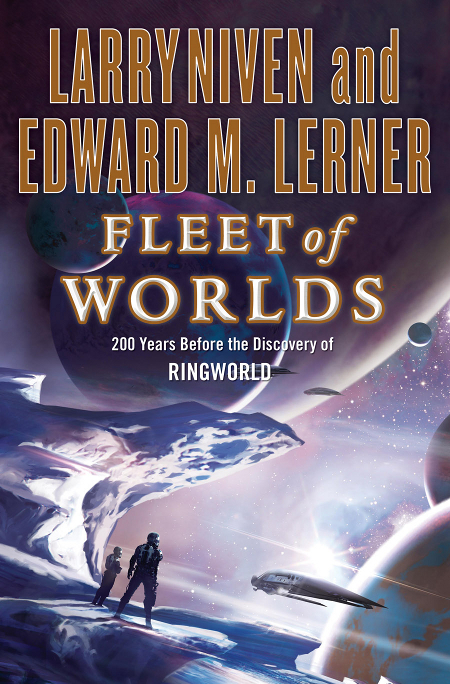
Where’s the love for cover artist Stephan Martiniere? Just busting your chops buddy. I do love the cover though.
The book sounds fun. I’m guessing I need to move it higher up on my TBR pile.
The covers for this whole series are great. I especially like the huge ship on Juggler of Worlds and the new novel Fate of Worlds echoes these same colors and looks great too! So glad Tor went with Martiniere for the whole series. Now they just need to do a nice hardback re-release of Ringworld with a Martiniere cover. That is a dream of mine.
I’m enjoying the second book even more. The human character who is the focus is an interesting one and they just brought in another character who features later on in Ringworld. Fun!
I haven’t read any of these books. Would you suggest/recommend Ringworld first and then the prequels. ‘Hard’ science fiction is not a problem for me. It’s just that sometimes when a middle book of a series is published first it is better to go with that one before beginning at the beginning. I am sure that you know what I mean. Thanks
It might actually be fun to go ahead and read Ringworld first and then start with this one. You’ll get the fun of seeing some of the Ringworld cast in these books and how events got them to Ringworld in the first place. I’ve only read Ringworld (of the older novels) and my plan now is to read through these 4 prequels and then read the rest of the Ringworld series leading up to these authors’ latest collaboration, the end of the Ringworld saga called Fate of Worlds.
Thanks Carl.
I’m actually kind of interested to get back up to the later novels just to see if the writing style, etc. feels dated given that they were written in the 70’s. These newer novels certainly feel current in their language and story structure.
Thanks for sharing this. I have somehow managed to acquire theses prequel novels. I will admit, though I have fondness for Ringworld, Engineers was a struggle. And I have attempted to get past the first few chapters of Throne, but it… it’s just…. I cannot. But I do look longingly at these prequels on the shelf. Once again, thanks for sharing!
Q
I have yet to give Engineers or the other post-Ringworld novels a try, but these have been really good so far. I hope you enjoy them. I think they benefit very much from being written more recently in that they have the flow of more contemporary fiction.