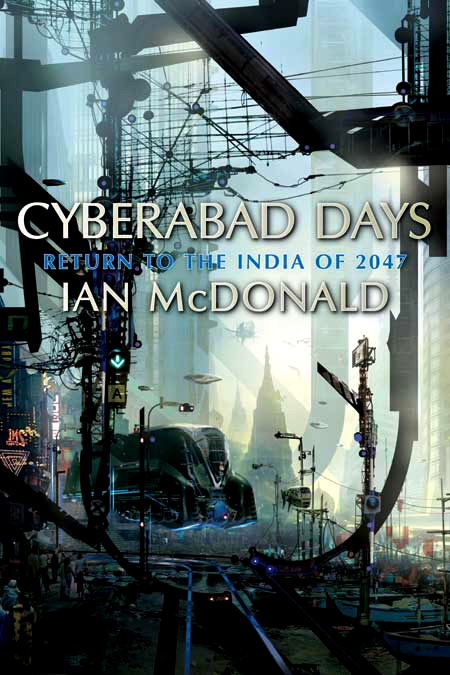
Cyberabad Days ~Ian McDonald
–published 2009
–Pyr Books
–268 pages
–“The Djinn’s Wife”, winner of 2007 Hugo Award for Best Novelette
–4.25/5 stars
Cyberabad Days is a return to the world of Ian McDonald’s BSFA-winning novel River of Gods. Like an exotic dish, this collection of seven stories (6 previously published, 1 new), is flavored with spices from the old world and the new. I savored hints of Isaac Asimov and Philip K. Dick amidst what I might have initially thought was an incongruous mixture: a Britain born son of Irish and Scottish parents writing stories set in a future India, steeped in that nation’s rich cultural heritage.
Cyberabad Days was a new and exciting literary experience, blending familiar science fiction ideas of future tech and artificial intelligence with a language and heritage that is far removed from my everyday experience.
Ian McDonald brings the history of the Indian people, albeit a “history” viewed from a time three plus decades in the future, in a way that sparks an interest in this diverse and storied nation.
The first thing that strikes one when picking up Cyberabad Days, and I assume the same thing holds true for River of Gods, is the language. Being wholly unfamiliar with the language of the region (except what little I’ve picked up from watching films like Bend it Like Beckham and Slum Dog Millionaire), I am unsure how accurate my assessment is, but it felt like McDonald created a blend of current and future Indian slang that gives his stories a unique lyrical flow. The closest that I can come to comparing it is the fact that while reading the very first story I was struck with the thought that McDonald’s writing had a similar musical quality to the work I’ve read by Haruki Murakami. Like Murakami’s collection After the Quake, the stories in Cyberabad Days do not fit together in a puzzle-like fashion, but they are all set against larger political events in the region, in this case an ongoing drought that leads to a water war, which gives them a sense of continuity. The authenticity of this social/political climate gives the science fictional elements of his stories a palpable sense of reality. The reader’s imagination is exercised in a satisfactory way without being stretched to the point of unbelievability.
The stories in this collection include:
Sanjeev and Robotwallah—
A worldly-wise young boy turns his robot/anime obsession to his advantage when he makes himself useful to the robotwallahs, teenage boys who don motion-capture equipment to control mechanized war machines to fight in factional skirmishes. This is one of my very favorite stories in the collection. McDonald’s style captures the rush of youth in the most musical of these stories. It only took a few pages of this story to make me realize that I had a) entered and entirely new world, and b) couldn’t wait to learn more about what this world had to offer.
Kyle Meets the River—
This story is told through the eyes of a young boy whose father is working in an instrumental fashion to rebuild the nation. The story does a lot to establish McDonald’s vision of India that will permeate the other stories in the collection. Kyle’s tale touches on the subjects of prejudice and cultural and socio-ecomonic upheaval while examining the familiar idea of friendship. McDonald also introduces a piece of technology that I, quite frankly, am dying to own–the lighthoek, or ‘hoek, for short. This device, worn over the ear (bluetooth style) gives the wearer access to an entire cyberworld overlaid upon the real world. It is a fascinating piece of tech that gives rise to some of McDonald’s most interesting story concepts.
The Dust Assassain—
A variation of the Montagues and Capulets, done Indian-style, only McDonald’s Juliet has been raised to believe she is a weapon. What manner of weapon remains to be seen. This story, another strong one in the collection, captures a sense of the heritage of the land. There is an Arabian Nights quality to the story blended together with the kind of futuristic touches that make each of these stories such a delight for the imagination.
An Eligible Boy—
The India of the late 2040’s has brought with it a sexual crisis. Years of selective breeding have given rise to a male population that outnumbers the female population four to one. In order to compete for the hands of eligible women, matchmaking parties–shaadis–give men the opportunity to make a good first impression. Enter Jasbir, a young man whose desire to stand out leads him to utilize the services of an A.I. relationship coach, an amalgamation of information constructed by Jasbir’s room mate from the various characters in the country’s favorite soap opera: Town and Country.
Here is another of McDonald’s intriguing story ideas: a soap opera acted out entirely by A.I.’s who believe (perhaps rightly so) that they have lives of their own and are merely acting out their soap opera personas.
An Eligible Boy is a lightly humorous, unconventional love story that deftly establishes the various levels of artificial intelligence present in this future society.
The Little Goddess—
This story delves more deeply into the rich religious world of the Indian people, with the various gods and goddesses. It tells the story of a young girl who becomes a goddess, and follows her as she rises, falls, and rises again. McDonald expertly captures the precociousness of a young girl who suddenly finds herself the personification of a being of worship, and as she grows in age so too does she grow as a character. Her personal adventures reveal a growing distrust of A.I.’s, especially those who are nearly indistinguishable from humans. While revealing the mounting tensions of the region, McDonald creates a multi-dimensional protagonist that I would love to see in future stories.
The Djinn’s Wife—
Here old and new magic combine as the story of Esha, a famous dancer, unfolds. Esha falls in love with an A.I., the djinn of the modern age. As various parts of the country push to pass through the Hamilton Acts–laws that would make artificial intelligence above a certain level illegal–Esha begins to question the decisions she has made with her life. The Djinn’s Wife examines, among other things, the concept of faithfulness in the cyber age. It also explores the ideas of connection and humanity, though not unique concepts in future fiction, in a new and exciting manner.
Vishnu at the Cat Circus
This is an original novella created for this collection. It has already been nominated for a BSFA award and would not surprise me at all if it garnered other nominations as the science fiction awards season rolls along. The narrator of this tale is an eccentric vagabond traveling with his Marvelous!, Magical!, Magnificent! cat circus. This turns out to be merely the bookends to a much larger tale, told by the ringmaster of this feline wonder, a tale that draws together the entire tapestry that McDonald wove with the other stories in this collection. Our protagonist is a Brahmin, a genetically engineered superior race that, among other things, grows physically at half the rate of a normal human being, thus giving them a longer life span. This slower rate of growth (combined with advanced mental growth) creates its own set of issues, issues that arise even before the child is born:
“After eighteen months of pregnancy, eighteen months of morning sickness and bloating and bad circulation and broken veins and incontinence and backache but, worst of all, not being able to smoke, my mother, with a great shriek of At last at last! Get the fucking thing out of me! gave birth on September 27, 2027 and I made my entry as a player in this story.”
Vishnu at the Cat Circus is, in one sense, a story of sibling rivalry, but in a much larger sense it is the story of the battle for mankind amidst the sociological, political, and economic tumult of a country with burgeoning technological advancement and yet a lack of the most important substance needed for life: water. It is a strong conclusion to this series of individual yet related short stories.
It is meant for better minds than my own to determine if one should enter Ian McDonald’s future India through the much larger novel, River of Gods, or through a sampling of various lives who inhabit that world, as is gathered in Cyberabad Days. My proclivity towards short stories and irrational aversion to weighty tomes makes it easy to see why I chose to start here. I started this year with Ian McDonald’s novel set on Mars, Desolation Road, and through that became a fan of his writing style. McDonald does something very different with these stories set in a culture very much different than that of the typical science fiction novel. That which impressed me with Desolation Road is present here, but it is obvious that McDonald has done some tremendous growth as a writer in the last two decades.
McDonald’s vision of a near-future India is filled with the kind of technological gadgetry that makes for exciting, jealousy-inducing reading and at the same time has the strong literary feel that more ‘respectable’ fiction often boasts of. This truly is literary science fiction, if one needs to label it. As for my personal experience, I have spent the last few days awash in words and images that are every bit as unfamiliar in my middle-class American life as are the imagined technological advances of the future. Woven within that unfamiliarity are stories of love and loss that ring true on an emotional level. I am very impressed with what Ian McDonald has accomplished here and can readily envision myself laying aside my fear of large novels to visit this India again in River of Gods.
And before I close, please allow me to heap praise upon Pyr for their excellent choice of covers, this one being another memorable one by a favorite, Stephan Martiniere.
______________________________
This book is a selection for The Sci Fi Experience 2010
Mind Voyages (for the Moon Voyage and Mars Voyage)
The 2010 42 Challenge
The 2010 Reading Challenge (for the Shiny & New category)
The 2010 Short Story Challenge
and
Agh!!! 18 months?!! I do more then swear! LOL LOL
Sounds like it’s worth the challenge.
Deslily: I don’t think you’re alone in that respect! 🙂
AlexJ: It really was for me, I’ll be giving River of Gods a shot as well based on my enjoyment of this one.
Oh, fascinating! I have River of Gods on my shelf and it’s been there for quite a while but I’ve not picked it up yet. I will have to read it soon and see if I want to continue the investment in India 2047 as presented here. I didn’t even know this book existed!
I have not even read the review, not a word of it. I just have to say I LOVE THIS COVER! I’ve seen it s few times before recently, and it just blows me away.
Okay, now I’ll go back and read the review…
This sounds so good and I’m not usually a short story person. The soap opera AI story sounded very Philip K Dick to me, when you mentioned they beleive they have their own personalities, so I’d like to give that a go.
Jodie: If you can track down a copy of this through the library or somewhere else then I would definitely give An Eligible Boy a try as that one first introduces the soap opera idea.
Richard: Yes, the cover is amazing!!! I was tempted to pick up the book earlier just because of that, but I held off until I had tried McDonald’s work and found out I liked it before pulling the trigger.
I’m curious, have you read the review now? Your thoughts?
Aarti: I have it now as well and am trying to decide just when I want to read it. I think I’m going to get a few other books in first before I go back to India. Might even read his book Brasyl in the meantime, have that in my library queue.
Yes I’ve read the review, it’s a well-written one and it’s in line with the other two I’ve read, though I think you may have liked the collection over-all a little more. I can’t think about anything else to read at this point, my reorganization (see my blog) is consuming all my time. I’m not even reading anything. I can work on the alpha work while watching television (mostly Olympics) but not while doing anything else.
Richard: I understand that. Best to keep at it steadily once you get started so that it all gets done. And, with the Olympics as background, this is the perfect time to be doing it.
I will be following your suggestion (elsewhere) and taking some pictures.
Richard, if you are interested, here are a couple of the do it yourself/reorganization posts I’ve done in the future:
http://www.stainlesssteeldroppings.com/?p=975
http://www.stainlesssteeldroppings.com/?p=982
http://www.stainlesssteeldroppings.com/?p=477
This looks so good. I’ve seen the River of Gods around and have been meaning to read it. An SF tale set in the future in India with all its history and mythology is just too tempting.
I’m not sure why, but a future India book just doesn’t sound that interesting. Maybe if it was set on a planet originally settled by colonists from that continent, but changed by the new environment. I guess when I think of India, I either think of KIM (time for a reread of that one?) or the current combination of industrial magnates, outsourced talking heads and crushing poverty and illness. Which I realize has nothing to do with the book, I’m sure. Or maybe it does, since the future is always a result of the past. Still, I sure do like that cover.
Perhaps in my late maturity (okay, I really mean “old age”) I’m getting a little too polarized in my thinking.
Another day of organizing, painting shelves, sanding, more painting, drilling new holes for the adjustable thingies, sorting, stacking, all that happy stuff. I’ll try to take some pics. I’m starting to wish this was over, and I haven’t even started on the books!! “Oh my, oh my!” said the white rabbit.
Richard: Paul McAuley writes and interesting and I think fairly accurate statement in the introduction talking about the fact that much of science fiction is an Americanized version of the future, to a lesser extent British, and other countries are far less represented in mainstream science fiction. This may be an overgeneralization, but it certainly has held true in my own personal reading.
Where this story works really well is it takes the ideas presented in stories like Minority Report, Do Androids Dream, Asimov’s robot stories and instead of setting them in a Western setting it sets them in a future India which has some of the continued problems that you mention but also has a class of people who can afford the latest gadgets and is in a world where tech will flourish to some degree even in the poorest parts of the country. Juxtaposed against that is all the beliefs of that nation, its magic if you will, and that makes for some very interesting ideas, especially given that some of the tech, especially the A.I. and the enhanced humans, in some ways bring their gods to life.
I wouldn’t want all of my sci fi reading to be examining existing cultures, but this was very well done and certainly peaked my interest in a part of the world that I give very little thought to.
Glad you are still plugging along with your reorganization. Can’t wait to see the results.
Sakura: Its “history and mythology” is exactly what makes it so interesting with the sci fi elements mixed in. I hope you enjoy it when you get a chance to read it.
Rats – had a long comment but dropped it when I moved to a different site from the wrong screen… I was saying you’re a very persuasive fellow. Now my question is this:
Should I read this before RIVER OF GODS (which the library has) or wait for a copy of this to pop up somewhere?
Hard to say Richard. I would preface this with the question of whether you are more of a fan of short stories or novels. I would probably recommend River of Gods, but then I haven’t read it at all. Plus RoG is a big commitment, whereas if you can snag this from a library you can read a story or two and decide if the writing style is for you. I found it very different than his writing in Desolation Road, which I also enjoyed.
I noticed that you can read the first part of The D’jinn’s Wife here on Asimov’s site:
http://www.asimovs.com/_issue_0607/Djinn.shtml
This is the Hugo winning story that I enjoyed but John DeNardo of SF Signal did not, and he really liked this collection as well.
Sorry you lost your comment, I hate it when that happens!
Can’t guarantee that you will like this kind of story. I don’t find it boring or uninteresting, but that doesn’t mean it will grab you like it did me. Of course I know you already understand that, so pardon the disclaimer. 😉
That’s the problem – the library had RoG, but does not have this title, nor is there a copy in bookswap. So I’ll have to a) wait or b) shell out the $10.50 plus shipping (Amazon) or $12.85 plus tax (B&N local store). I’m tempted to wait for a copy of the ss collection, because if I like the writing, I can go with the novel at any time, from the library.
Also, changing the topic to mystery fiction but a similar venue (well, sort of) have you read anything by Colin Cotteril? I really liked The Coroner’s Lunch and will be reading Thirty-Three Teeth soon.
I must profess my ignorance of Colin Cotteril. Although the title The Coroner’s Lunch sounds very familiar. Will you be doing a review? Will have to add him to my list. I have a pile of Hard Case Crime books, some old McGinnis covered books, and several Charles Todd mysteries to catch up on. Plus I’m really wanting to re-read Jedediah Berry’s The Manual of Detection and do a proper review of it since I neglected to do so last year. And I want to get back to reading the Bond books from where I left off.
So much to read!!! 🙂
You got that right. And I’m still stuck in this reorg limbo. I’ve struck a tricky bit (making a template for drilling a new set of holes to accommodate different pegs for the new shelves so they will be adjustable, and making everything level…) and sit staring at it thinking the “how” of it through… and I want to be reading instead.
I actually thought about that when my dad helped me build the bookshelf in our bedroom and decided that I just didn’t want to go through the hassle of adjustable shelving. Best of luck to you! 🙂