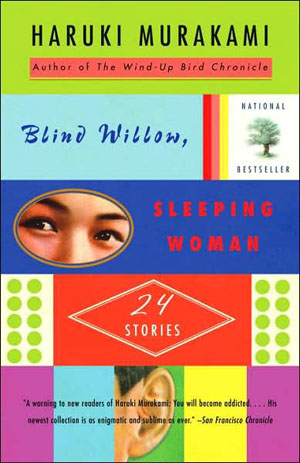
Blind Willow, Sleeping Woman ~Haruki Murakami
–published 2006
–362 page, Vintage Books
–4/5 stars
I worked with a guy back in my Tulsa days who could tell a story about how he painted a barn and you would be enraptured by his every word. He wasn’t particularly charismatic, he was just a simple man. Ollie could tell a good story.
Haruki Murakami shares that quality with Ollie, perhaps more so than any author I have ever read. Why? Because his stories do not have to necessarily be about anything other than the average day to day existence and can still have you hanging on every word. It is an amazing and hard to describe phenomenon. As he did with After the Quake and After Dark, Murakami had me reading story after story in rapid succession, each story compelling me to read ‘just one more’ before I went about whatever tasks I had set before me that day.
Professional reviewers have labeled this collection of 24 stories both “wonderful” and “disappointing”. And I think both words are apt descriptions for the various stories scattered throughout this book. The reason being is that these 24 tales cover the entire range of Murakami’s writing career, from his first short stories ever published to more recent works. As such they reflect a writer at various stages in the crafting of his skill. Oddly enough, I found stories that were early Murakami creations that I enjoyed every bit as much as later works. Short stories, as with novels, are certainly a ‘beauty is in the eye of the beholder’ genre of works. I would be the first to admit that because I am new to Murakami and have not gotten used to or tired of his conventions, and because I am more than ordinarily fond of the short story genre, my experience with Blind Willow, Sleeping Woman may not be that of the average reader…or more particularly the average Murakami reader. I enjoyed the heck out of this collection and even the ‘disappointing’ stories were interesting to read. Because Murakami can tell a good story.
In the introduction to the book Haruki Murakami shares some thoughts on writing and particularly on short stories:
“To put it in the simplest possible terms, I find writing novels a challenge, writing short stories a joy. If writing novels is like planting a forest, then writing short stories is more like planting a garden. The two process complement each other, creating a complete landscape that I treasure. The green foliage of the tree casts a pleasant shade over the earth, and the wind rustles the leaves, which are sometimes dyed a brilliant gold. Meanwhile, in the garden, buds appear on flowers, and colorful petals attract bees and butterflies, reminding us of the subtle transition from one season to the next.”
Subtle is a good description for the stories in this collection. A sense of loss, a window into the lives and loss of others, and an gentle reminder of what it is to be a human are just a few of the threads Murakami weaves into his stories. There were too many stories that I enjoyed, and far too few that were utter disappointments, for me to talk about each one in detail. Perhaps my least favorite of his tales were Dabchick and The Rise and Fall of Sharpie Cakes, both of which would make perfect R.I.P. III reads. The reason for my disappointment is that these creepy tales reminded me of stories with a similar feel to some eerie Neil Gaiman short stories but Neil’s feel more polished and are more effective. Don’t get me wrong, they were still enjoyable to read but were the few that left me feeling that they could have been so much more.
Great stories were woven throughout the tapestry of this book. I particularly enjoyed the story about a man who made spaghetti for every meal for a year. It was a story whose ending really grabbed hold of me, but I have to admit that even with a more obscure ending Murakami had me sitting at his feet in rapt attention. I have often said that Neil Gaiman could read me the phone book and have me hanging on every word. Haruki Murakami could write about Neil Gaiman reading the phone book aloud and could achieve the same effect. They are both so effective in this genre.
Before I end this general overview of the book I wanted to include another passage from a very interesting story entitled A “Poor Aunt” Story:
All right, then, where do the lost names go? The probability of their surviving in this maze of a city must be extremely low. Some are flattened on the road by enormous trucks, some die in the gutter for simple lack of spare change that would get them on a streetcar, while others sink to the bottom of the river, with a pocketful of pride to weigh them down.
Still, there might be some who have survived and found their way to the town of lost names where they have built a quiet, little community. A tiny town, at the entrance to which there would have to be a sign:
NO ADMITTANCE EXCEPT ON BUSINESS
Those who dare to enter without business, of course, receive an appropriately tiny punishment.
Isn’t that a delightful passage? I just love the way Murakami phrases things. Short stories live and die by the skilled economy of the usage of words and in my brief sojourn with Haruki Murakami I am ready to declare him a master. He is a true storyteller, and a man that captures the essence of the human condition in a way that is not only difficult to describe but is unique among writers that I have had the pleasure to read. I cannot think of anyone else I’ve read who could describe a trip to see a kangaroo at the zoo that essentially is nothing more than that and isn’t particularly life-altering but still satisfies so completely. This collection ends strongly with several stories in a row that I really, really enjoyed and the last one, The Shinagawa Monkey, is fantastic. Such a great way to end the collection.
If you have not read the works of Murakami I would certainly suggest picking up After the Quake first if you want to read short stories or After Dark if you want to sample one of his shorter novels. After those two, this is a worthy book to add to your collection. I look forward to taking more journeys with Haruki Murakami this fall.
_________________________
This is my second book read for the second Japanese Literature Challenge hosted by Dolce Bellezza.
I STILL haven’t read any Murakami!! But I will. I’m so stuck in RIP though, I think he will just have to wait!! I have After Dark as one of my selections for the Japanese Challenge as well.
And I’m fast becoming a fan of the short story.
Stephanie: Yes you are, I enjoy reading your short story review posts. It is exciting to see someone else enjoying the genre. I look forward to your thoughts on After Dark when you are able to get to it. I hope you find it as intriguing as I did. There is certainly a creepy element to the secondary storyline that might allow it to be counted as R.I.P. and Japanese Literature Challenge if you want to kill two birds with one stone.
I love Murakami, he makes me remember my time in Japan.
Carl…what’s up with your blog? I can’t see any images anymore, just google placeholders.
I don’t know, does that happen when you hit ‘refresh’ as well, because I am not having that problem but someone else was the other day.
I’m having that problem with your site in my google reader. IF I open your blog in a new window, I can see the pictures. Weird.
This sounds interesting. One of my closest friends is like that, they can talk about anything and you get right caught up in it. I keep telling them that they could write a book! This is an author that I really should read, but since I don’t own any books by them, I am going to try and resist the temptation!
As to short stories… after saying I wasn’t a big fan of them I am currently reading another collection. Seems to be my theme for the R.I.P challenge. 🙂
I haven’t read any Murakami. I’ve got The Wind-Up Bird Chronicle on my shelf, waiting for me to read for the Bellezza’s challenge, but I don’t know…you’ve really tempted me. Maybe I’ll have to pick up one of his short story collections to try first. (That dang book buying ban is highly overrated anyway.)
Debi: I’ve started Hard-boiled Wonderland and the End of the World for my third book for Bellezza’s challenge and it is very interesting thus far. I am going back and forth between it and R.I.P. reads right now. Book-buying bans…who needs ’em? 😉
Kailana: Yes, you are proving yourself wrong! You may turn out to be a fan of short stories yet! 🙂
Carrie: Thanks for that clarification. I think that happens because the server security is trying to block people from image stealing by directly linking to images, so if a person doesn’t come directly to my site that will happen. At least that is what I understand is occurring.
I have yet to read Murakami, but love hearing how many people adore his work. I have After Dark on my TBR pile, but its always Kafka on the Shore that jumps out at me most..I think its the cat on the cover!
All the Murakami books I’ve read prompt a similar response; that was great, but I’ve no idea what it was all about 🙂
Fence: Certainly some of the short stories are like that. I cannot really speak about the novels at all. I didn’t think After Dark was too much that way. Certainly some storylines where unfinished but overall I felt the story had a beginning, middle and end. It is odd because he does really seem to be that sort of an author and yet I enjoy his stories so much that I don’t care. I didn’t think I’d ever like stories like that but I do! Weird!
Mariel: Make sure you let me know when you’ve read After Dark, I just loved that novel.
I have this book! I still haven’t read it though but I might be moving it up in my TBR pile now.
Hey Carl,
I finished reading After Dark before I started the RIP challenge; I’ve also read The Wind-Up Bird Chronicle and After the Quake. I’m tempted to go buy this volume of short stories now but I must resist as I have Norwegian Wood, Sputnik Sweetheart and Kafka on the Shore all unread on a bookshelf!
I enjoy how he writes about the mundane in a way, as you say, where you want more… I like the darkness and bleakness of his work too; it reminds me somewhat of Joyce Carol Oates’ work although they are very different (and Murakami is less devastating and more enjoyable), that complete disillusionment about the empty void…
Paperback Reader: Yes, you certainly have enough Murakami on the shelf to resist temptation. But it is still hard though, isn’t it? 🙂 I hope to get to Norwegian Wood sometime this fall/winter season. “I enjoy how he writes about the mundane in a way…where you want more”. Great way to put that, I love that as well.
Ladytink: Whenever you get around to reading it please let me know so I can check out your review.
I’m so glad you’ve discovered Murakami this year! I have this collection in my too-big TBR pile so I probably won’t get to it quite yet. Good to know you enjoyed it though.
BTW, just to add to the problem seeing images, in this post right now I can see the cover at the top of the post, but at the bottom, where I assume you have the JLit Challenge logo, all I can see is a Google placeholder. This is how it looks both in my Google Reader and at your site.
Some kind of Google Gremlins? It is R.I.P. season after all! 😉
What a beautiful description of the difference between writing novels and writing short stories!
Heather: Isn’t it though? I love the way he writes.
Tanabata: I am too, it was obviously too long in coming. I should have trusted all of you more a long time ago.
I sent you an email reading the image issues and would love to hear if anyone else is having similar issues.
I love that passage on short stories! I’d seen some mixed reviews of this one and that’s why it wasn’t a priority on my Murakami list, but you’re really making me want to read it.
About the image issues: When I look at your posts through google reader, all I see are the google logos. But when I click over to your blog the images show up just fine.
Thanks Nymeth. It is weird because I went and used Google Reader for the first time and the images all show up fine for me through there. This is certainly the issue, however.
I’m really interested in what long time Murakami fans think of this. I’ve read 3 books in rapid succession so to me I didn’t have the wait in between books issue, or the I’ve read a bunch of Murakami issue to compare it to. It may be a disappointing collection for long time fans, but there were enough really memorable, enjoyable stories in this collection for me to feel like it is worth reading.
I still haven’t read any of his short stories but have certainly been wowed by some of his novels. I’d love to get to After the Quake for one of my challenges but we’ll see…
Oh yes, and I’m also seeing the google image instead of your pics. How weird.
Carl, this was my first every Murakami book. While I now jump around saying, “I have a new favorite author” to anyone who will listen, I did not feel that way when I first read this. Unlike you, I do not classify short stories as a particularly beloved genre, so that was my first barrier. Secondly, I was looking for a bang (i.e. wrap it all up with a pwerful lesson) at the end. For those reasons, I laid this down a tad disappointed.
However, since then, I have read After Dark (loving it as much, or more, as you did), and Kafka on the Shore which absolutely MESMERIZED me. If you ever felt so inclined, I’d love to discuss that one with you; talk about enigmas, description and dwelling with the characters. Holy Cow! Anyway, I want to pick Blind Willow, Sleeping Willow up again, because after all, Murakami is my new favorite author. Ever. And, you’ve written a bewitching review.
Bellezza: As I’ve mentioned in the post and subsequent comments, it really doesn’t surprise me that this isn’t everyone’s favorite collection. It isn’t my favorite, but the stories I enjoyed I REALLY enjoyed. I’ll certainly be reading Kafka on the Shore at some point in the future as I no doubt will eventually get around to reading all of his books since I am enjoying his work so much. I’ll be willing to discuss it at length, no doubt, once I’ve read it.
I read Norwegian Wood last year and I just adored it. I have to put more Murakami on my list!!
Daphne: Several people commented about Norwegian Wood when I read my first Murakami, After the Quake, and it has gone on my list. I’ve been told it is a good autumn read, so when the weather gets a bit more melancholy I’ll be tucking in to that one.
Hey, I tried that 100 words, no repeat thing. Man, was that a tough exercise!!
It’s here:
http://5elementknitr.blogspot.com/2008/09/be-gentle.html
I have never read any of Murakami’s work, but I often look at his books at the bookstore. I’m just never sure whether I will (one) like him and (two) know where to begin!
Begin with After Dark or, if you are into short stories, with After the Quake. I highly recommend After Dark though as it is a brief book with very interesting, engaging characters.
Hi Carl,
Nice to meet you, I’m from Belgium :]
I was surfing the internet and I found this cool blog.
I was happy to see Murakami Haruki’s book on your blog. I’ve read all his works by years and I must say I LOVE all his works! I’d like to recomand if someone who know little about Haruki’s works, I’d like to recomand the his first successed novel : ” norwegian wood ” – then she/he can explore Haruki’s world by other works with realeased years as well- When I read his “norwegian wood”, I was about 21yrs, it was 1992 – and since I’ve discovered his work, my world has been changed as well. Oh, his essay is relly good too. By the way, sorry for my broken english!