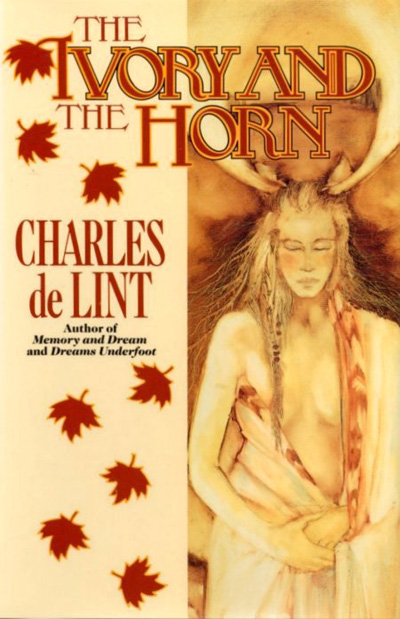
The Ivory and the Horn ~Charles de Lint
–published 1995
–Tor Books
–318 pages
–4.5/5 stars
If there is one thing that Charles de Lint does well (and trust me, there is more than one), it is to write short stories that work well in and of themselves yet carry the additional weight of being masterfully woven into the tapestry of a shared universe. In the sense of Charles de Lint’s work, this universe is the fictional North American city of Newford.
This collection of short stories, with a cover image by the incredible Terri Windling (which fits the spirit of de Lint’s stories so very well), is another gem, and has added to my esteem for his writing ability and this world that he has created.
This review is a bit of a departure from my normal structure in that I read this as a joint-read with Kailana and we are co-reviewing it. We decided to do this by asking each other a set of questions about the book. What follows are my answers to Kailana’s questions. Click here to go to her site to read her thoughts on the questions I posed to her.
1. How did this short story collection compare to other books you have read by Charles de Lint? Would you recommend it to others?
The Ivory and the Horn was my third foray into the short story collections of Charles de Lint. The other two collections, Moonlight and Vines and Muse and Reverie (click each title to see their respective reviews), were both outstanding and this one ranks right up there with them. I gave the overall collection a slightly higher rank than I did the other two, but there is not enough of a difference that I would classify any of the three as the one someone “must” read over the other two.
I would highly recommend this collection to anyone, especially during the Once Upon a Time Challenge. I’ll go more into the reasons why I recommend this when I answer question number three.
2. What was your favorite story in this collection? Were there any that you didn’t like as much?
These seem like they would be easy questions, and they might with another writer, but de Lint does so much with his stories that I find it easy to love certain ones unequivocally and yet be drawn in and grabbed hold of by others where I don’t particular enjoy the choices the characters made or the outcome of the story, and such was the case with a few of these.
I really enjoyed the opening story, Waifs and Strays. It just felt so real, so plausible. It was easy to relate with the burdens of the main character and her struggle to maintain. The emphasis on relationships and on allowing people to help share your burdens really spoke to me.
I loved Mr. Truepenny’s Book Emporium and Gallery. I’ve always been fascinated by stories in which a person’s imagination creates an alternate world that in fact isn’t a dream, but is made real. I thought the entire story was very magical and it was the story (the second in the collection) that kicked up the spark of the spring/fairy tale mood for me and made sure I didn’t put this collection down until the very end.
I was very frustrated by The Wishing Well, and yet would argue that it was the best written story of the collection. My frustrations stemmed from the main character, Brenda. What frustrated me the most is that I’ve known so many people like her in my lifetime and they drive me absolutely crazy. I’m almost ashamed to admit how intolerant I felt about her as the story went on. Her body image issues and poor choices and short sightedness and poor boundaries, etc. It was such a well told story yet I found myself wanting to rush through to see if she would ever, pardon my french, get her shit together. It brought home to me many things, including the fact that I obviously need to look at why those issues in particular brought up such vivid feelings for me, especially given the fact that I work in a helping profession. Probably a sign of burn out and needing a vacation more than anything else. I was also very disappointed by the ending of this story on some levels. Spoilers follow until the end of this paragraph: I was happy that she got help and was coming around, but I was really disappointed that her relationship with Jim did not pan out. I liked the guy and was hoping for the fairytale ending. Probably why de Lint is a successful writer and I am not—he has the courage to go for the more plausible ending, even in a story filled with fantastical elements, and I’m not sure I could do that.
The last story in the book, The Forever Trees, was another that I wasn’t wildly happy about, again because of the choices the characters made and how it affected their lives. I like melancholy stories, but this one passed slightly beyond my definition of what makes a melancholy story good.
The Forest is Crying was one that really touched me. As a social worker I so readily connect with the character of Christopher Dennison. I’ve met him in other stories and each time have really liked him and the story. Although I saw the end coming on this one, it didn’t effect my affection for the story. I don’t think de Lint was trying to fool anyone or pull a twist, I think the point of the story was the true, although sometimes cliched, idea that we do have an impact on the lives of those around us.
Dennison returns in Bird Bones and Wood Ash, a deliciously dark tale that is a guilty, but cathartic, pleasure for anyone who has strong opinions on what should be done to people who abuse other people.
I really need to stop or I’ll end up writing about every story in the book, but I must mention The Pochade Box. I liked the story so much, and it is so close to the last story, that I really wish the collection would have ended with it.
3. What is it, in your opinion, that makes Charles de Lint’s stories what they are?
As I mentioned in my opening paragraph, de Lint does so many things well. He writes realistic, believable characters. Even those characters who believe in the supernatural and the mythical, who have special powers or communicate with mythical creatures, feel as real as the people we interact with every day. To that he adds a deep knowledge and understanding of myth and folklore and the power of spiritual things in our lives and the importance of that connection. Above that he has a unique voice when it comes to social ills and broken people. His stories, set in a realm that borders on the fantastical, are filled with characters who have been abused, have been and may still be downtrodden, who have significant and serious baggage that, in our world, often makes them the cast outs and the unwanted. He brings a humanity to all of his characters without laying on the saccharine or manipulating his audience emotionally. Not only are his stories wildly entertaining because they feel like the essence of spring in word form, but they open your heart and mind in ways that can positively affect your interactions with others. They are never preachy, but they do have a message. And one last thing, de Lint brings art, poetry, and music to his stories and his expertise in these areas is very telling. He knows what he is talking about. And the fact that I am a fan of the kind of Celtic and folk music that often inhabit his stories makes me like them even more.
As lame as it may be to say it, the pen of Charles de Lint is enchanted and his stories are filled with magic.
4. One of the things I really enjoy about de Lint is that he can write both female and male characters entirely believable. Would you agree? Were there any characters in this collection you thought he captured particularly well?
I completely agree. I sometimes wonder how valid my opinion is of his ability to write female characters because I am, of course, a male, but from my viewpoint he captures the essence of womanhood as well as or better than he does what it is to be a man.
As for characters, it is probably unfair to even mention Jilly Coppercorn, because I’ve been in love with her since I first read Widdershins. It is always intriguing to read these early stories of her life, before events happened that made her the person she is in The Onion Girl and Widdershins. Reading about her in these stories and knowing about parts of her later life just reaffirm my belief that de Lint is a master at creating fully formed characters.
I mentioned above that I really enjoyed Christopher Dennison. It was easy to empathize with him given that I work in the same field and have experienced the same triumphs and tragedies that he has in his career.
Is it asinine to say that after all is said and done that I really do like Brenda, the character who drove me nuts through most of her story? De Lint really brought her to life for me and I couldn’t help but feel that I had been through hell and back with her by the end of the story.
There were others, but I’m being so long-winded with all my answers that I probably should stop there.
5. Another thing that I love about de Lint’s writing is that there were several times throughout the story collection where I had to pause and think ‘wow!’. There were sentences and paragraphs that were rather inspiring and captured things so well. Do you remember any moments like that?
Now you’re going to make me work! There were indeed, but enough days have passed that I’m going to have to go thumb through the book a bit.
Okay, I’m back.
It may seem like cheating, but I did love the Oscar Wilde quote de Lint included at the beginning of the book, “We are all in the gutter, but some of us are looking at the stars.”
From Waifs and Strays:
“I take her hand and we leave the building. I know it’s not going to be easy; but then nothing ever is. I’m not afraid to work my butt off; I just don’t want to lose sight of what’s really important.”
Simple, common-sense, oft-quoted sentiments, but that doesn’t take away from the truth in them.
When I read this part of the story about Mr. Truepenny:
“Naturally, not just anyone will do. It has to be the right sort of person, a book lover, a lover of old places and traditions, as well as the new”
I couldn’t help but want to cry out, “pick me!!!”
I can’t help but admire de Lint’s voice. Although each story has a similarity in that it comes from him, he has the talent and ability to give different voices to different characters. The writing in Saxophone Joe and the Woman in Black has such an interesting rhythm:
“What gets me is how everybody’s looking to make sense of things. Sometimes you don’t want sense. Sometimes, the last thing in the world you need is sense. Work a thing through till it makes sense and you lose all the possibilities.”
I really enjoyed the entire interplay of the last conversation in The Pochade Box. Again, simple everyday wisdom that we all so easily forget or gloss over rather than embracing it and living it.
Thanks so much Kailana for the great questions and for suggesting we give a partner read a try again after I dropped the ball last year. It was fun and we will do it again. Please take a moment to go over to Kailana’s site to read her thoughts on the book (click here) and for heaven’s sake add some of de Lint’s Newford stories to your to-read list. You really can jump into Newford anywhere and you’ll soon find yourself at home to some really first rate storytelling.
_______________________________
This book is a selection for:
The 2010 Support Your Local Library Challenge
The Short Story Challenge 2010
The Short Story Reading Challenge 2010
and the
Great answers! I am looking forward to another buddy review with you in the future! Reading de Lint always leaves me wanting more. 🙂
I love Mr. Trupenny and was just thinking about the wishing well story literally yesterday when I was walking home from BART. I first read these stories years ago and haven’t re-read them, but they stick with you, you know? I adore Charles de Lint.
Between reading your post as well as Kailana’s, I wonder, why I have not read a de Lint book yet? Seriously. I love fantasy books, so the genre is threre. I have heard of de Lint but yet, I have not read one single book. That must change. Your answers have really sparked my interest and curiosity in his writing. Now to gifure out which book to start with. Do you have any recommendations for a first de Lint read?
Before I begin reading the pair of posts, may I say it’s an inspired way to co-review the book.
** Applause **
The three deLint books I have in my catalog are Circle of Cats, Moonheart and Spiritwalk, the latter being the sequel to Moonheart. I’ve READ only the first of those books though I see Moonwalk has a bookmark about 20 pages in. No idea why I stopped there, but I’m sure it’s been 5 years since I saw that bookmark… Now to your reviews and I’ll have more comments later.
um, that was supposed to be that Moonheart has the bookmark in it… (got to learn to proofread…)
Richard: Thanks, wish I could take some credit for it, but it was all Kailana’s idea. It was fun to do. Circle of Cats is a book that I really want to get my hands on.
Ibeeg: I’m not just saying this because it happens to be the book we just reviewed, but this really would be a good place to start. I would stay away from some of de Lint’s much earlier work just because, from what I’ve read of others’ thoughts, it isn’t quite as polished as most of his Newford stuff is.
Caitlin: They really do stick with you. I was at an art show last night and it wasn’t hard to be thinking of Jilly and some of de Lint’s other characters while I was there.
Kailana: Yes, let’s do it again.
I haven’t read this one… so glad that de Lint is prolific, as his books are magic and there’s always another one for me when I need my de Lint fix. I am not a fan of short stories, but I do enjoy de Lint’s short stories.
Daphne: de Lint certainly writes some of the best short stories. And I too have a loooong way to go before I run out of Charles de Lint books to read. Which is a wonderful thing!!!
Is Circle of Cats not available, in print? You do know it’s illustrated by Charles Vess, right?
Richard: I’m not sure. I do know that it is illustrated by Vess and I’ve seen a copy and really do want to get it at some point. Looks like such a lovely book.
He’s one of the authors whose work I would really like to work methodically through; I love the idea of multiple works that share a setting and character set and allow you to feel fully immersed in their world all the more as you read along, book after book.
Me too! I’m slowly but surely doing just that.
I have a copy of Circle of Cats you borrow someday if you want to and can’t find one. I read it a couple of years ago and enjoyed it. It was a nice story not great but good but what is excellent is Vess’s artwork.
I’m so glad you enjoyed this – I just love his novels and short stories. I had fun reading both of your buddy reviews!
The one book of his I’ve read I did not like. Turned out to be a departure for him, a mystery/thriller with no fantasy elements. I do want to give him another go. I’ll look for one of his short story anthologies. Sounds like that’s where I should have started with de Lint in the first place.
CBJames: I’m not sure I would like a de Lint book without fantasy elements, so it doesn’t surprise me that it didn’t sit well with you. Another mistake I think people make in trying de Lint is to go too far back into his earlier stuff. I definitely recommend it being a Newford short story collection or a Newford novel. The only de Lint I haven’t liked is actually his latest novel, The Mystery of Grace.
Darla: I’m glad it was so much fun. I’ve started Someplace to Be Flying and am really enjoying it thus far. Has the crow girls in it…I love them.