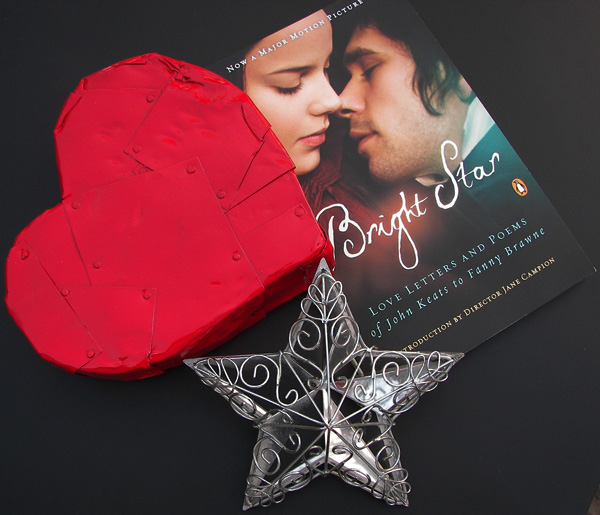
Bright Star: Love Letters and Poems of John Keats to Fanny Brawne ~John Keats
–this collection published 2009
–Penguin Books
–130 pages
–4/5 stars
I recently reviewed the beautifully tragic love story of John Keats and Fanny Brawne as adapted in Jane Campion’s film, Bright Star. I was so impressed with Keats’ poetry in the film that I picked up the companion book as a gift for my wife for her birthday…then promptly borrowed it to celebrate the beginning of National Poetry Month.
After a really nice introduction by Jane Campion, the book Bright Star contains the letters that Keats wrote to Fanny, followed by several selections of his poetry. What I was initially struck by was how grateful I was that I had seen the film before reading the letters. While quite beautiful in their expression, the presence of some context of what was going on in Keats’ life at the time of their penning added significantly to the experience of reading his letters.
What struck me next was the fact that, despite being a prodigious talent, his letters contained the same kind of passion and angst which dominated all of our teenage years. Keats was in his very early 20’s, Fanny was still a teenager, when Keats first experienced the pangs of the kind of love he had previously mocked. His rhapsodies on her beauty coupled with his anguish over being separated from her and declarations that she would be better off without him ring with the kind of unbridled emotion that accompanies first love. I could not help but feel any love notes I wrote in my day to be the work of monkeys banging typewriters when compared to the talent one can see in Keats’ writing.
“For myself I know not how to express my devotion to so fair a form: I want a brighter word than bright, a fairer word than fair. I almost wish we were butterflies and liv’d but three summer days—three such days with you I could fill with more delight than fifty common years could ever contain.”
“Forgive me if I wander a little this evening, for I have been all day employ’d in a very abstract Poem and I am deep in love with you–two things which must excuse me.”
Reading these letters cannot be done without being touched with pangs of sadness, knowing that the outcome for the two would not be the stuff of ‘happily ever after’. Keats was no stranger to sickness and death in his life. In speaking of switching the pain of so much death and sickness surrounding him for the pain of love, he writes, “Ask yourself my love if you are not very cruel to have so entrammelled me, so destroyed my freedom.”
Following the letters are 13 of his incredible poems. I have said before that I am not well versed in the art of poetry, pardon the pun. I’ve certainly read poems over the years that I like very, very much, and others where I clearly do not get either what the poet was trying to accomplish nor have the eye/ear to discern if the poetry is any good. In the case of someone of John Keats’ talent, even my untrained palate can identify the genius of what he created.
Among my favorites were the titular poem:
Bright Star
Bright star, would I were steadfast as thou art —
Not in lone splendour hung aloft the night
And watching, with eternal lids apart,
Like Nature’s patient, sleepless Eremite,
The moving waters at their priestlike task
Of pure ablution round earth’s human shores,
Or gazing on the new soft-fallen mask
Of snow upon the mountains and the moors —
No — yet still stedfast, still unchangeable,
Pillow’d upon my fair love’s ripening breast,
To feel for ever its soft fall and swell,
Awake for ever in a sweet unrest,
Still, still to hear her tender-taken breath,
And so live ever — or else swoon to death.
and poetic stories that fit nicely in the current Once Upon a Time IV Challenge:
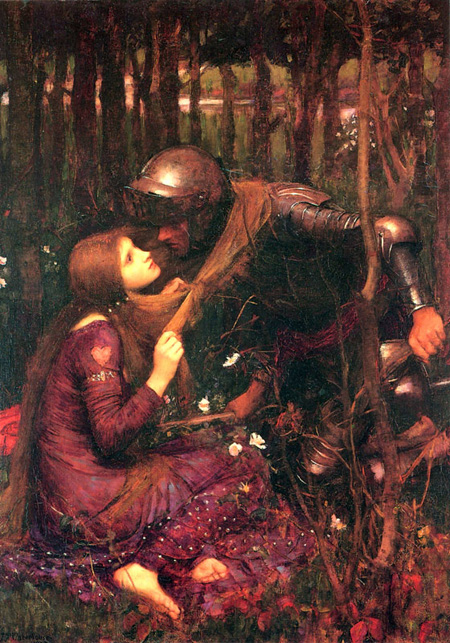
(painting by John William Waterhouse)
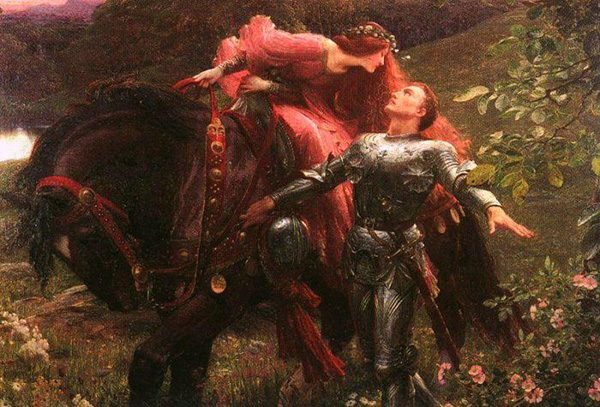
(painting by Sir Frank Dicksee)
La Belle Dame Sans Merci, is a mysterious ballad that seems to speak of the border between the realm of faerie and our own. I had no idea until reading this book that it was Keats’ poem that inspired these Pre-Raphaelite works that I have long been fond of.
The Eve of St. Agnes which was a terrific, and somewhat racy (especially for the time) story based on the superstitious belief that a woman could see her future husband if a certain ritual was performed on the eve of St. Anges Day. It was very, very good.
and
Lamia, which is a fantastic story of gods and godesses, again perfect reading for this time of year.
John Keats, whose life was tragically cut short, has lived on through his work for almost two centuries because his poetry deserves to endure. It speaks for itself and is, in my opinion, quite accessible for non-poetry aficionados. Watch the film, read the book. Happy National Poetry month!
What a wonderful review. I’ll have to add this to my ever-growing list of books that must be read. I love John Keats’ work and this would provide some insight into the poet.
I hope that you will consider placing your National Poetry Month link in Mr. Linky at my month-long blog tour post here: http://www.savvyverseandwit.com/2010/03/welcome-to-national-poetry-month.html
And I hope that you will check out some of the other tour stops along the way.
Hmmm…first Ana, and now you, with these love letters of poets…I don’t think I’ve ever read a review of a book like this before, and now two in one week.
Carl, you did at least let Mary read the book first, didn’t you? 😉
Debi: She read the introduction and I believe all the letters part. Not sure if she finished the poetry section. I waited two weeks before snatching it for my own read…that’s fair, right? 😉
Savvy: I will visit your site and post my link. As I said in the review, if you haven’t seen the film I would highly recommend both it and the book as companions to get some really nice insight into Keats and an appreciation for his work.
I don’t read much poetry either, although occasionally I’ll come across something which stuns me. I first read bits of Keats in Dan Simmons’ Hyperion saga and after that I’ve been meaning to read some more of his poetry. I can’t wait to see this film.
Sakura: Someone else mentioned Keats in Hyperion lately which made me even more intrigued to try that series out.
Happy National Poetry Month back at you. I read Lawrence Ferlinghetti’s A CONEY ISLAND OF THE MIND yesterday, long a favorite book of poems.
Margarey Allingham wrote the introduction to BRIGHT STAR as by her detective’s wife? Cool.
Richard: Yes she did!!! Ha! Speaking of, I love the British movie series based on Allingham’s books.
Haven’t heard of Lawrence Ferlinghetti, but that title stirs the imagination.
Was ‘This Living Hand’ in that collection? Probably not, since it’s way more R.I.P than love-lettery, but it’s my favorite Keats. To save you a google search:
This living hand, now warm and capable
Of earnest grasping, would, if it were cold
And in the icy silence of the tomb,
So haunt thy days and chill thy dreaming nights
That thou wouldst wish thine own heart dry of blood
So in my veins red life might stream again,
And thou be conscience-calmed—see here it is—
I hold it towards you.
Ack, right? Right.
Raych, yes, This Living Hand was in this book, and I liked it. Very R.I.P. worthy was my thoughts as well.
Ferlinghetti owned a book store in San Francisco named The City Lights Bookstore which became known as the heart of the “beat” movement in the 1950s and was later a mecca for hippies in the Love Generation years. Ferlinghetti published the collection of poems HOWL by Allen Ginsberg, which was banned across the U.S. Howl was dedicated to Jack Kerrouac (On The Road) and William Bourroughs (Naked Lunch) Ferlinghetti himself was a wonderful poet and wrote more than 30 books of poetry.
In one of his poems, Ferlinghetti say of a dog:
he had a real tale to tell,
and real tail to tell it with
I’ve heard of that bookstore, and I’ve met some of those dogs. 🙂
I watched Bright Star last week and loved it. It was such a beautiful movie and story. The poem is now one of my favorites too. It is so tragic about Keats…he was so talented and poor Fanny who had to lose one she so loved. Naturally, I was in tears!
Michelle: We were all in tears too watching it, I’m not ashamed to admit.
YES! I absolutely LOVED the movie, as well as Keats’ poetry when we did it in college. I never knew this book existed, it’s going straight to my TBR pile! 😀
BTW, you got yourself a new follower!
Ah, beautiful poems! I, also, am not well-versed with poetry. Many times I don’t even know how to read them properly. But yes, Keats’ poetry do sound like the ones you wish you had thought of when writing love notes in high school 🙂 Thanks, I’m gonna look into his poetry now.
Excellent post! And “Bright Star” is particularly poignant since a revision of the sonnet was the last thing Keats wrote.