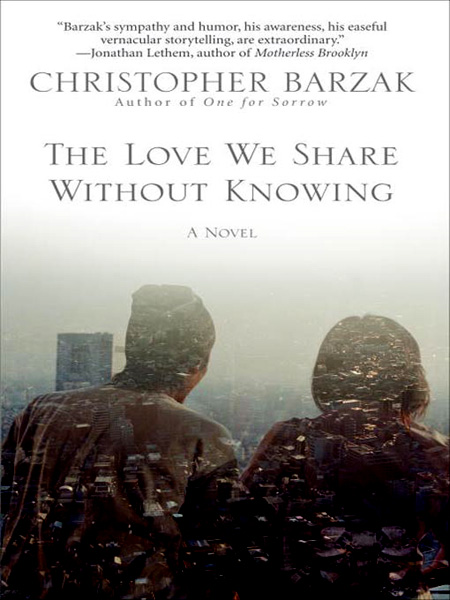
The Love We Share Without Knowing ~Christopher Barzak
–published 2008
–Bantam Books
–288 pages
–Best Novel Nebula nomination for upcoming 2009 Nebula Awards; 2008 James Tiptree Jr. Award Honor List
–4/5 stars
Ever since the sad but understandable retirement of Endicott Studio and the Journal for Mythic Arts I am sorry to say that I have not maintained the strong awareness I used to cultivate of the authors and artists who continue to keep the movement alive. For those of you who have, the name Christopher Barzak is probably a familiar one, as his short fiction has been published with the work of many of the big names in mythic fiction over the last few years. If it were not for the recent list of Nebula nominations, my ignorance of Barzak’s work would have continued. As it was, I found myself in my local library on Friday, tracking down a copy of his latest book, The Love We Share Without Knowing. My assumptions based on the cover art and story synopsis made me curious about what seemed like an odd nomination for an award that is generally given to more obvious genre fiction.
The butterfly effect, in one very simplistic explanation, asserts that something very tiny and insignificant can have long-lasting, far-reaching effects. When applied to humanity, the idea is that we matter, that simple decisions we make effect the lives of those around us, which in turn effect the lives of others and so on. The Love We Share Without Knowing is a series of interconnected short stories that demonstrate this very thing. The fantastical elements are subtle and sparse in these stories of the lives of Japanese and American people living in and around Tokyo. The book is, among other things, an examination of the effect of culture on people who live with that culture and those who, by their own or other’s choices, end up being immersed in an unfamiliar culture. It is also about the things all of humanity share: love and loss, grief and hope, life and death.
With a simple, elegant style Barzak presents lives in a sometimes bleak, not overly sentimental manner. The book starts out with a slightly melancholic but ultimately hopeful story of an American teenager who feels the isolation of being a stranger in a strange land. To combat this he takes up running, a hobby which leads him to a greater connection with the Japanese culture and a fateful meeting with a very interesting young girl. This story was a great start to the collection and my expectations were raised. Those expectations were soon tempered as the next two stories in this continuing mosaic were dark, austere portraits of humanity. They were real, and sometimes what is real in humanity is not what I necessarily want to face in what I consider to be a recreational activity. Barzak’s writing style was so quietly compelling that I just kept turning the pages and in so doing was rewarded with an unconventional but surprisingly hopeful reading experience.
One of the many enjoyments in reading this book was the way that I was surprised by which characters would reappear in the narrative. I was equally surprised by those that did not. Often I was so involved with the current protagonist’s story that I had forgotten about a certain character until Barzak wove their life into the narrative of the current story. Throughout The Love We Share Without Knowing I found myself comparing it to my first experience with Haruki Murakami with his short story collection, After the Quake. While they are very different works, there is a thematic kinship in that both are what I call “slice of life” stories. Murakami is a master at placing his readers into a specific moment in the timeline of what then feels like a very real life. Though I am not ready to commit sacrilege by placing Christopher Barzak in the same echelon as Haruki Murakami, Barzak does manage to do something similar with his writing.
Though I suspect that The Love We Share Without Knowing is not for everyone, I do feel that it is a novel that has earned its inclusion in awards discussions. Whether or not it fits in with the Nebula Awards is something that could lead to some interesting discussions, particularly if it wins. The fantasy elements of this book lie mostly in the realm of ghosts are certainly not a major component in the overall length of the story. They are, however, a very important key to the story being told which is one of the reasons why I can understand the nomination. If you are the kind of person who hopes to see genre barriers obliterated, then The Love We Share Without Knowing may be your talisman. If you prefer your genre fiction to be kept in more easily identifiable categories, Barzak’s book’s inclusion in the Nebula Awards short list might be muddying your water.
I’m not sure where I stand on the issue and may not have a definite opinion unless I am able to read the other novels that are nominated (I have read Boneshaker and am currently reading Finch). I don’t think either side is intrinsically “right” or “wrong” as I see virtues on both sides. I like going into my local bookstore and having a “science fiction and fantasy” section in which to look for books where I will have a general idea of what I am looking at. I also really enjoy discovering books like this one that expand my reading horizons. Whatever the case may be, The Love We Share Without Knowing is a thought-provoking book that I enjoyed reading and I will be checking out the short fiction of Christopher Barzak that I have missed.
_________________________
Despite all the books I have checked out of the library this past month, this book is my first completed selection for the 2010 Support Your Local Library Challenge.
Also a selection for the 2010 Reading Challenge in the Who Are You? category.
“If you are the kind of person who hopes to see genre barriers obliterated, then The Love We Share Without Knowing may be your talisman.”
…which I am 😛
I’m very glad to hear you enjoyed it, Carl!
Wow, I do like the sound of this. This was a wonderful review, Carl. Really sounds like something I’d enjoy. I love reading about other cultures – especially tales of people being places in cities and towns that aren’t those that they’re used to.
I’m going to put this on my wishlist. You’ve made it sound really interesting.
Thanks for this great review, Carl. I have this one on hold at my library and am excited for Barzak. The Nebula nomination is wonderful.
A fine review Carl. You’re up to your usual high standards with this one.
I have doubts: “The fantastical elements are subtle and sparse in these stories of the lives of…people…” and “The fantasy elements of this book lie mostly in the realm of ghosts [and] are certainly not a major component”. The occasional use of one or more ghosts in a book-length short story collection hardly seems sufficient to qualify a book as genre Fantasy in my opinion. Obviously the book has it’s proponents or it would not have made the short list of nominees. My guess it it will not win based on the more traditional definitions used by a majority of the voters.
This doesn’t sound like something I’d particularly care for, and for the very reason you give: “The next two stories in this continuing mosaic were dark, austere portraits […] sometimes what is real in humanity is not what I necessarily want to face in what I consider to be a recreational activity.” It’s a recreational activity for me too, and my goal is enjoyment, not betterment. As soon as I get a whiff if didactic writing, hopeless darkness or doomed protagonists I usually turn off. That doesn’t mean I’ll only read Uncle Scrooge or Tom Swift Jr., but it does mean I don’t have a lot of read it because it’s good for me left in me these days. There are too many good books that I’ll enjoy without going out of my comfort bounds.
If that’s narrow-minded (and it may well be!) so be it. We old fuddy-duddies have the prerogative, as you’ll no doubt learn for yourself in 25 years or so. 😉
But I do thank you for this review, for it’s a nicely crafted explanation of the book, background, overview and detail. I feel as if I have an understanding – as good as one can have without reading it – of “The Love We Share Without Knowing.
Richard: Thanks for sharing your thoughts. I firmly believe that if my review doesn’t make you want to read the story then you probably wouldn’t enjoy it. Despite that, this is certainly not the kind of book I would consider one that a person should read “because its good for me”. It isn’t that kind of story at all, it is just another in a long line of literary works with some magic realism elements that does prove that a mixture of elements can work. I know this isn’t a “betterment” book simply because I too am not attracted to those kind of books. Ha! 🙂 Joking aside, if ANY book doesn’t entertain me then I stop reading, so something like this has to do the same thing that any other book does which is to hook me and keep me interested. The first chapter really did that. I can tell you that if the second chapter of the book had been the first chapter it would have went straight back to the library! Something happens later in the book that redeems a part of that chapter which also influenced my overall liking of the story.
I don’t think it is narrow-minded of you at all. We all have too many books to read and not enough time. That’s why I won’t be reading Proust any time in my lifetime! This is a really good book, but if I were to recommend this kind of book to someone who doesn’t read this type of thing normally, I would recommend Murakami first and foremost, that being from the mere handful of books I’ve read that are set in Japan.
I personally would not be surprised at all if the book wins the Nebula. If it doesn’t it wouldn’t be something that would disappoint me from the standpoint that I feel Barzak’s writing is top-notch. I would, however, wonder if the committee was searching for some kind of legitimacy, as a certain sector of sfandom seems to always be craving (myself excluded). And that too I think is a sad and cynical viewpoint that I have because it could be that Barzak here is legitimately breaking ground…again this is a really good book…but I fear that there is a chance that if he does win it might be tainted by an outcry by the more traditional fans.
Then again, I’m probably making much ado about nothing. 🙂
Gavin: Please let me know when you’ve read it so that I can check out your review.
Ceri: I’ll echo my statement to Gavin, that if you get around to reading it I’d love to know what you thought.
Nymeth: I’m glad I enjoyed it too. I hit that “keep going or give up” point after the second story but decided to just keep going for a bit longer and then I was hooked. I was very thankful that the end story made a really great bookend with the first story and that hope and not pessimism was the overriding theme of the book. I’ve read two or three books like this in the past that could have been great but then crashed at the end. I was pleased to see that Barzak, unlike those authors, actually knew how to end a book and end it well. (Here I’m thinking specifically about de Lint’s The Mystery of Grace and also the book The Brief History of the Dead).
I am sort of surprised that I missed you earlier review of the book.
You had me at After the Quake. It’s easily one of my favorite Murakamis.
Lu: Its mine too, although I’ve only read After Dark and Blind Willow, Sleeping Woman. As my first Murakami experience, and a positive one at that, it will always be the memory by which I judge other books of his that I read. I guess I did also listen to his nonfiction book about running and writing, which was good too. I have started Hard-Boiled Wonderland and the End of the World and need to get back to it.
“Butterfly effect”? Genre-bending? Murakami? I think I have to read this one–I hadn’t heard of Christopher Barzak before today. Thank you for another mind-expanding review, Carl.
Lovely review, Carl. Catches my interest in a number of ways, and I love the cover!
JenClair: My guess, based on what I see you review and like, is that you would enjoy this one. At 288 pages it is a really quick read (it isn’t a large book size-wise either so it isn’t your standard 288 trade paperback pages).
ds: I think all my buzz-words fit with the story that Christopher Barzak wrote. You’re very welcome. 🙂
This sounds very interesting, and it has a great cover. The title makes me think it’ll either be a thought-provoking read or something trying too hard to be hip. Because of your review I’ll go with the more favourable option 🙂 it also sounds like something my library should have so I’ll check tomorrow, and if it doesn’t will have to see about ordering it in
Fence: Unlike Murakami’s work there aren’t a lot of pop culture or music references in this one so not a lot that would push it into a ‘trying to be hip’ category. It is more thought-provoking.
I meant to say in my review that I look at books like this, and Murakami’s work, as the literary equivalent to people-watching. If you like doing that in any capacity then there is an aspect of these books that will appeal to you.
Reading your reviews cost me money, bcause they make me want to buy more books. Unfortunately I don’t have the time to read all the books you review. I wished I did, becuase you discover such wonderful reads. I will keep The Love We Share Without Knowing in mind. I checked, and it wasn’t at Audible, which would have been great. I can find more time to listen, but still not enough to keep up with you.
Barzak does have a blog to promote the book
http://christopherbarzak.wordpress.com/the-love-we-share-without-knowing/
and a podcast about writing the book here
http://www.randomhouse.com/bantamdell/podcast/200812.html
Jim
ps. I also found Christopher’s Barzak’s bookshelf at GoodReads. It’s rather fun to see what books influenced him:
http://www.goodreads.com/review/list/325382?view=covers
He does read a lot of genre books, so he knows about the SF field.
Wow, what a spectacular review! You know there’s no one who compares to ‘my’ Murakami, but to have you say that Barzak reminds you of him is all I need to pick it up. I love those slice of life vignettes that Haruki taught me to appreciate. Thanks for making me aware of this work, and this author, Carl.
Bellezza: Great, I really thought this might be something you would want to check out.
Jim Harris: Hey thanks, and thanks for the links. I’m looking forward to seeing what his other short fiction looks like.
I’m glad to hear you enjoyed this, Carl. I read it last year and didn’t realize just how much it affected me and just how much I liked it until several weeks after reading it and I found myself thinking about Barzak’s stories; they didn’t hit me over the head, but instead they slowly insinuated themselves into my mind. I love it when that happens.
Terri B: “slowly insinuated themselves into my mind” is a great description of what this work does. I too have thought about this since reading it and know that aspects of these stories will stay with me for a long time.