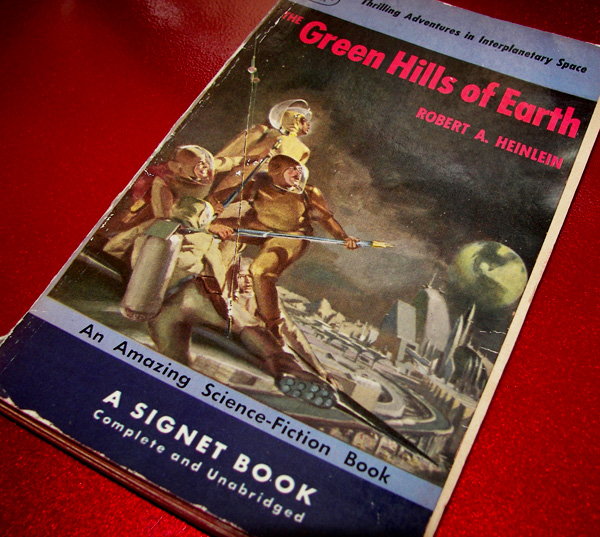
The Green Hills of Earth ~Robert A. Heinlein
–published 1951 (Signet paperback 1952)
–Signet Books
–176 pages
–4/5 stars
Having finished Desolation Road, which felt like a series of short stories tied into a larger tale, I was still in the short story mood. I have also been itching to get back to reading more Heinlein, so when I found a copy of The Green Hills of Earth in my basement, it seemed liked the next logical place to go. It was a very good choice.
The Green Hills of Earth is a collection of ten of Robert A. Heinlein’s stories, all written in the 1940’s and published in various magazines. The stories are part of his Future History, an imagined history of the progress of mankind from the middle of the twentieth century on through the 23rd century. Having this ‘shared universe’ makes each story feel as if it is part of a greater whole and thus place names, events, characters, songs, etc. pop up in various stories that have been referenced in other stories. I am partial to this kind of writing, it is like having the best of both worlds in that there is the world-building of a series and yet the pleasure of reading self-contained tales. From Wiki:
The Future History was nominated for the Hugo Award for Best All-Time Series in 1966, along with the Barsoom series by Edgar Rice Burroughs, the Lensman series by E. E. Smith, the Foundation series by Isaac Asimov, and The Lord of the Rings series by J. R. R. Tolkien, but lost to Asimov’s Foundation series.
I certainly haven’t read all of these, but that is really good company! (On a side note, it would be interesting to see what would win today and what other series might be included).
The more I read of Heinlein’s early work the more impressed I become with his storytelling abilities, and The Green Hills of Earth just adds to his stature in my eyes.
In the excellent introduction by Mark Reinsberg, he makes mention of the fact that Heinlein’s tales have a “homely realism”. They feel like slices of life rather than far-out adventures, despite their science fiction underpinnings. His men, women and children, even when viewed through the lens of the societal structure of the time period, remind us of people we know, people we have met. Reinsberg also mentions Heinlein’s familiarity with the moon, Earth’s celestial partner, which features in some fashion in many of these stories. While Heinlein’s future sees man dwelling on the moon, it is presented in a way that is reasoned out and perhaps jibes with the knowledge of the time. The moon is an inhospitable place, made livable by hard work and feats of engineering, not by some magical vision of a moon that does not exist.
I don’t like to summarize short stories. The very nature of them being ‘short’ stories means that it is far too easy to give the whole thing away. I will share some thoughts on each of them, however.
Delilah and the Space-Rigger (4/5 stars):
I am ever fascinated by Heinlein’s treatment of women. In some stories they are powerful, strong, independent–presented in a way that was very forward thinking of the time. In other stories, like Delilah, there is a definite stamp of the time period on it. As I began reading this story I felt that it smacked of the later. But then I thought about it some more. This is a story about women encroaching on what was traditionally the domain of the male. It is a story about the threat of women in the workplace, at least what was felt like a threat for much of the twentieth century. As such I think the story is very genuine in its portrayal of all the characters. On top of that, it is a fun story and one that has the right spirit about it.
Space Jockey (4/5 stars):
In this story Heinlein portrays the very real strain on relationships, in this case a marriage, that a dangerous profession can have. Through Jake, Heinlein details a very matter of fact space travel system and through the eyes of both Jake, and his wife Phyllis, we see two people whose love and faith in each other are tested by the need to make a living. This too is a very enjoyable tale. I have learned with Heinlein that you cannot always guess where a story is going to lead, and this one held me in suspense until the very end.
The Long Watch (4.75/5 stars):
This is a great story. Johnny Dahlquist is a great every man hero. This is a story where the reader is handed the end right at the beginning, yet it is told so well that mid-way through I had forgotten about the beginning and was intensely involved in just what Johnny was trying to do–save the world. I really liked Dahlquist. Though my time with him was brief, his was a memorable tale, a real gem in this collection.
Gentlemen, Be Seated (3.5/5 stars):
This story is a perfect example of what I said before about Heinlein’s ‘realistic’ treatment of life on the moon. In Gentlemen, early construction is underway and three men on a tour of the work find themselves in a situation that demonstrates just how dangerous the taming of a new frontier can be. I enjoyed the heck out of this story right up until the very end. It was well paced and suspenseful and I could feel the claustrophobia that Heinlein describes. Where the story loses marks is at the end where Heinlein wraps the whole thing up with a quick paragraph that, while not necessarily unsatisfactory, is done so quickly that it mars the effort put into leading the reader to that point. I have to assume this is the result of editing to fit a pre-determined magazine space. That is the only thing that makes sense.
The Black Pits of Luna (4.75/5 stars):
In my brief experience I find myself of the belief that when it comes to writing kids, Heinlein is a master. Early on I found myself once again wondering what it was that caused Heinlein to marginalize women in some of his stories in a way that was completely different than other stories. A few pages later it dawned on me–this story is seen through the eyes of a young boy, a boy in transition who views both his mother and his father with the kind of loving contempt that kids go through as they begin to assert their independence. Young Dickie doesn’t paint a flattering portrait of familial life and yet it is not a particularly bad portrayal either. This is an adolescent view of family life and though it has some of the sensibilities of the 1940’s, it carries with it the weight of realism. We have all felt this way about our mothers and fathers at some point growing up. This story is also brilliant in that Heinlein writes a character that cannot help eliciting emotion: our protagonist’s younger brother, “Baby Darling”. You ever meet a kid that you just want to take behind the woodshed? This is that kid! But it is that “somebody please choke this kid” feeling that makes the story so powerful. This was an engaging tale with a nice ending that gave me a little lump at the back of my throat.
It’s Great to Be Back (4/5 stars):
You can see the end of this ‘grass is always greener’ tale coming a mile away. But it does not matter in the slightest. The time spent with Allan and Josephine is no less enjoyable because of this. This is very much a ‘slice of life’ story. Nothing particularly profound, yet the tried and true moral of the story bears remembering as we go about our daily lives.
“-We Also Walk Dogs” (3/5 stars):
I’m not ashamed to admit when I don’t quite get a story, and this was one of those. It isn’t that there is anything wild or ‘out there’ about it, it is a tale of corporate politics that is all too familiar to anyone who has experienced it. What I did not ‘get’ was the point of the story. There was certainly something else going on here that I was either too tired or simply not bright enough to see.
Ordeal in Space (4.25/5 stars):
Heinlein tackles a couple of fears in this collection, this one being a fear of heights. William Saunders is a man with a paralyzing fear, one that effects his life in a very profound and debilitating manner. Through flashbacks brought on by, of all things, the cry of a kitten in need, we learn just how William developed such an intense fear of heights. Perhaps I just have a vivid imagination, but I could feel this fear as I read the story. This is a really fine example of why I like short stories so much. In only a handful of pages Heinlein made me feel for and identify with William, and I grew quite fond of him in those few pages.
The Green Hills of Earth (5/5 stars):
The story from whence this collection gets its title is itself the title of a song made up by Heinlein from a phrase he found in a story by author C.L. Moore. The Green Hills of Earth is the story of Rhysling, The Blind Singer of the Spaceways. It is a story told in the format of a magazine article that contains lines of verse from some of Rhysling’s songs. Though told with the trappings of science fiction, this story would be every bit at home in any setting. Rhysling is the kind of character we have perhaps all seen many times before–the wandering minstrel, the begger with a good heart and plenty of stories to tell. Rhysling is more than that though. Rhysling is a hero. A man who sang songs that in turn will be the subject of songs yet unwritten. There is no need to say anymore. This is a great story, showcasing Heinlein’s ability to craft great verse as well as great prose.
Logic of Empire (3.75/5 stars):
What starts as an innocent bar room conversation turns into a nightmare for Humphrey Wingate. After a long night of drinking Wingate awakens to find himself bereft of the freedoms he had previously enjoyed in life up until that point. This is a very interesting story with social applicability not only for the time in which it was written but also for today. Well told and really gripping, right up until the very end. And it was the end that lead to my slight disappointment with this story. It felt watered down and a bit too open ended for my preference. Or perhaps ‘open ended’ isn’t the right description, as the characters do have their stories resolved, again not unsatisfactorily, except in the rendering of the ending on the printed page.
All told this was a very enjoyable collection of stories, and taken as a whole they open the window on Heinlein’s Future History, giving us a glimpse of what our history could still be like some day. If you are interested in bite-sized samples of Heinlein’s work, and/or are a fan of short stories, I highly recommend this collection.
_________________________
As you can see from the photo, mine was a well-loved copy of The Green Hills of Earth. As I mentioned in my review of I, Robot one of the pleasures of reading these science fiction classics is doing so from a book that has its own tales to tell because of its long life. With this copy of The Green Hills of Earth I experienced the bittersweet knowledge that this is most likely this book’s swan song. It was already falling apart when I opened it and continued to do so as I read it. Yet I gently read on, knowing that this book had come a long way since coming off the press in 1952, sixteen years before I was born. I’m a sentimental fool, to be sure, but I enjoyed giving this copy of The Green Hills of Earth what it deserved–one more chance at instilling awe and wonder.
_________________________
This book is a selection for The Sci Fi Experience 2010, Mind Voyages (for the Mercury Voyage), the 2010 42 Challenge, the 2010 Reading Challenge (for the TBR category), and for the 2010 Short Story Challenge
You may recall this is one of the Heinlein books I said is a personal favorite, and for all the reasons you state. Excellent review!
Richard: I did indeed and I can certainly see why it is a favorite. There are many really fun stories here. I was talking to a friend about some of the stories this evening and got excited about them again just talking about ’em.
since coming off the press in 1952, sixteen years before I was born
I don’t know a book I could say that about..but I think the tablets Moses read after coming off the mountain might have been 16 yrs before I was born! heh
Glad you liked it. I’ve only read the first two stories in The Green Hills of Earth so far and enjoyed them both. I skipped the rest of your story reviews until I get a chance to read them soon then I’ll return with more comments.
I will add now though that I think I finally understand where people have commented that John Scalzi’s writing reminds them of Heinlein’s. It’s your quote from Mark Reinsberg’s introduction that made it click for me. He comments on Heinlein’s tales have a ” homely realism “. I think that’s it in a nutshell. Scalzi has a way of doing that, too. Scalzi is able to give his tales that slice of life quality that Heinlein was able to do. I will note that my copy of The Green of Earth is a later edition and doesn’t have Mr Reinsberg’s introduction in it which is a shame.
Somehow I missed this one! Love the old cover art, too.
AlexJ: It is definitely worth tracking down, I assure you.
Jeff: Interesting that you bring up Scalzi because after reading this I was thinking once again that his writing really reminds me of and gives me a similar feeling to Heinlein. I don’t think he is a direct match, but there is definitely a Heinlein vibe in what Scalzi does, at least for me personally.
Deslily: LOL! 😉